
Could Humans Ever Travel Faster Than Light?
Faster-than-light travel is not a barrier waiting for a better engine — it is built into spacetime itself. Here is what physics forbids, what it quietly allows, and how humans could still reach another…
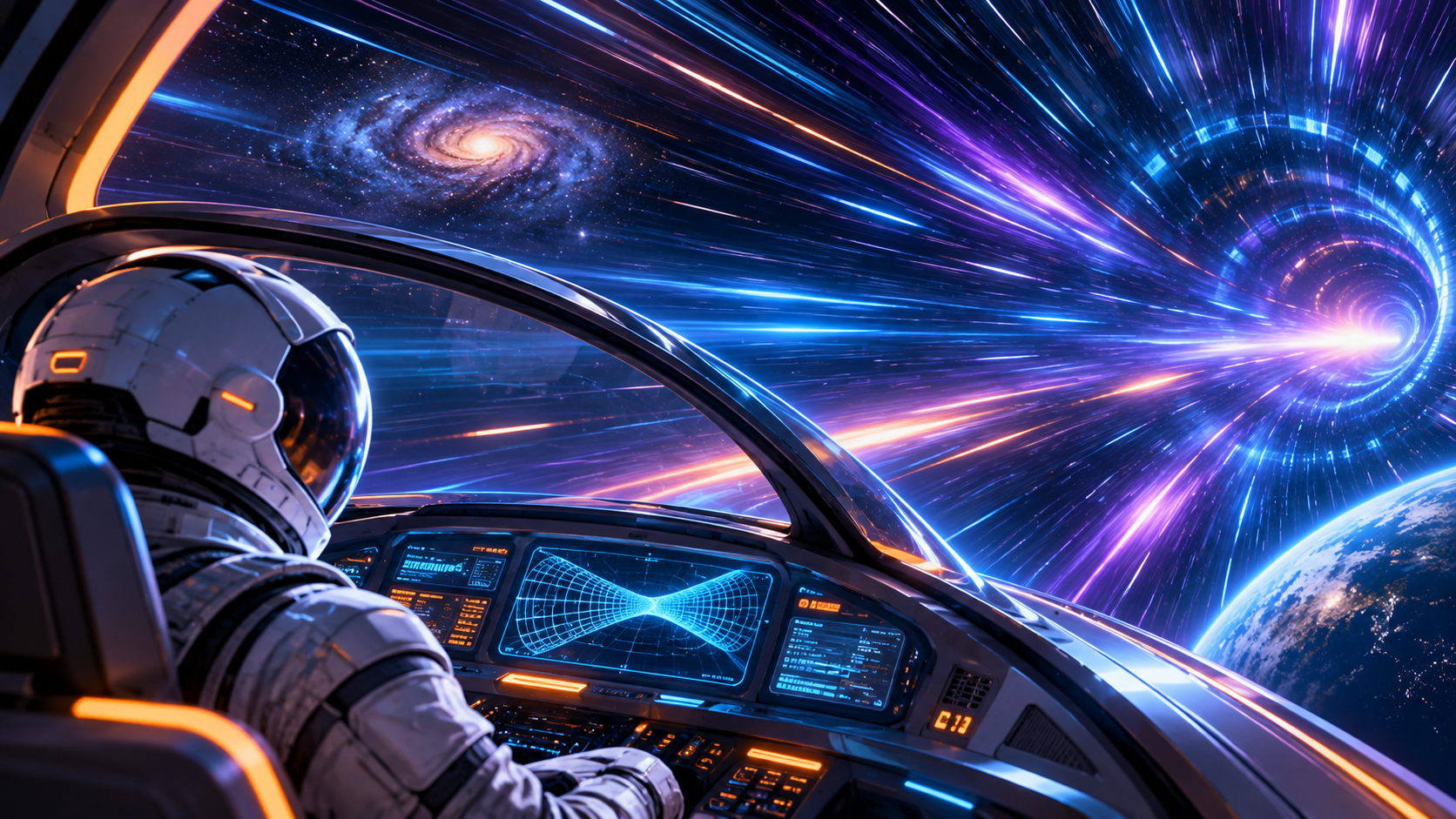
Every science-fiction story that spans a galaxy quietly assumes the same thing: that somewhere in the future, someone works out how to travel faster than light. Without it, the stories do not work. The distances are simply too large.
So the question deserves a serious answer rather than a dismissive one. Can humans ever travel faster than light? Not by accelerating a spacecraft through space — that door is closed, and the physics behind why is unusually solid. But that is not the whole answer, because there are a handful of exotic loopholes that modern physics does not actually forbid, and a set of slower-than-light options that could still put human beings in another star system.
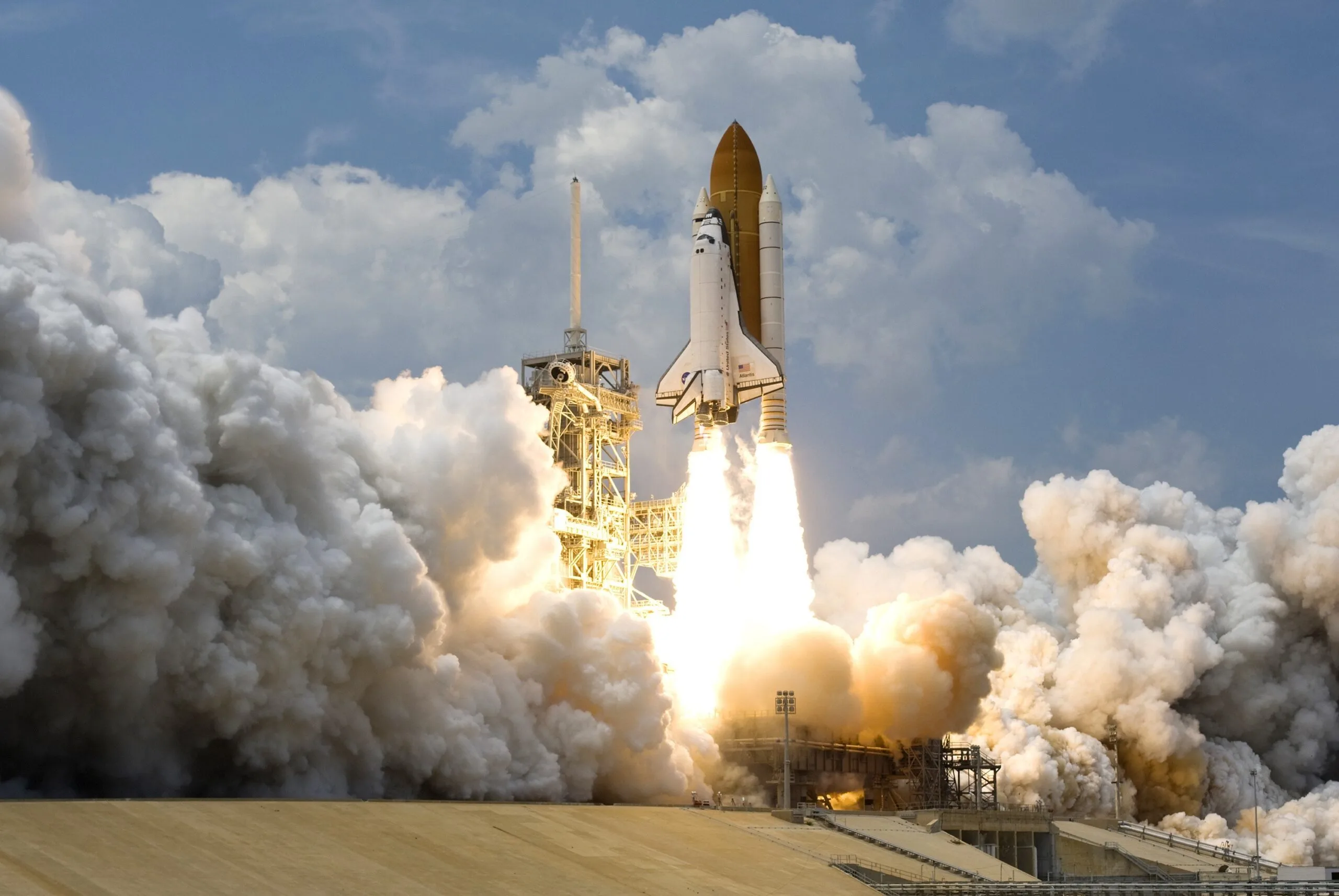
This guide separates what is impossible from what is merely absurdly difficult — and explains why those are very different categories. If you enjoy the practical end of this subject, our look at the realities of space travel covers the nearer-term picture.
The Short Answer
No — not in the way films depict it, and almost certainly not ever.
The speed of light is not a technological barrier like the sound barrier was. It is built into the structure of space and time. Nothing carrying mass can reach it, no matter how much power you throw at the problem, because the obstacle is not engineering. It is geometry.
But three things complicate that flat "no":
- Several things in the universe already outpace light without breaking any rules
- Relativity permits strange shortcuts — warp drives and wormholes — that require materials nobody has ever found
- Thanks to time dilation, a crew could cross enormous distances in a short personal lifetime, even while never exceeding light speed
That last point is the one most people miss, and it matters more than any warp drive.
Why the Speed of Light Is a Hard Limit
To understand why this barrier is different from every other barrier humans have broken, you have to look at what the speed of light actually represents.
It Is Not Really About Light
The constant written as c — roughly 300,000 kilometres per second — is poorly named. It is not fundamentally a property of light at all. It is the maximum speed at which cause can produce effect anywhere in the universe.
Light travels at that speed because photons have no mass, and anything massless is obliged to move at exactly c. Gravitational waves travel at the same speed for the same reason. Light just happens to be the messenger we noticed first.
Calling it "the speed of light" makes it sound like a traffic rule that a better engine might break. A more honest name would be the speed of causality.
The Energy Problem
Here is the obstacle in its simplest form. As an object with mass accelerates, its relativistic mass increases. The faster it goes, the heavier it effectively becomes, and the more energy each additional increment of speed demands.
Push toward 99% of light speed and the energy cost climbs steeply. Push toward 99.99% and it becomes extraordinary. Reach 100% and the required energy is infinite — not "more than we can generate", but mathematically unbounded.
This is not a limitation of current reactors. Every particle accelerator ever built confirms it. At CERN, protons are routinely pushed to more than 99.9999% of light speed, and they still fall short. Add energy and they gain mass rather than meaningful speed. The limit has been tested continuously for decades and has never once bent.
Time Dilation and Length Contraction
Approaching light speed does not only cost energy. It distorts the journey itself.
Time dilation means a fast-moving clock ticks slower relative to a stationary one. Length contraction means distances in the direction of travel compress. Neither is a trick of perception — both are measured routinely, and satellite navigation would drift badly without correcting for them.
At light speed itself, the equations stop producing sensible numbers: time would not pass at all, and distance would shrink to nothing. That mathematical breakdown is the universe declining the request.
The Causality Problem
The deepest objection is not about energy. It is about cause and effect. Spacetime behaves in genuinely counterintuitive ways under extreme conditions — as the direct evidence of a rotating black hole demonstrated — but even there, causality holds.
Under relativity, observers moving at different speeds disagree about the ordering of events that are far apart. Normally this is harmless. But if information could travel faster than light, some observer would see the effect occur before its cause.
Build a genuine FTL communicator and you have, unavoidably, built a machine that sends messages into the past — with every paradox that implies. This is why physicists treat the speed limit as close to inviolable. Breaking it does not just allow fast travel; it dismantles the logic of cause and effect.
Things That Already Travel Faster Than Light
Several phenomena outpace light without violating anything. Each one is instructive, because each one shows precisely what the rule forbids.
The Expansion of the Universe
Space itself is expanding, and the further away a galaxy is, the faster it recedes. Beyond a certain distance, galaxies recede faster than light — and will never be reachable, their light never arriving.
No rule is broken because nothing is moving through space quickly. Space is being created between objects. The cosmic speed limit governs motion through space, not the stretching of space itself. Observations from Hubble and the James Webb Space Telescope have mapped this expansion in detail — and this loophole is the seed of every serious warp-drive proposal.
Quantum Entanglement
Two entangled particles share a linked state. Measure one and the other's state is fixed instantly, regardless of separation. It sounds like faster-than-light signalling.
It is not, and the reason is precise: you cannot control the outcome. The result of each measurement is random. Both parties see random noise until they compare notes — and that comparison travels by ordinary means, at or below light speed. Entanglement is real and useful for encryption, but it transmits no usable message.
Shadows, Spotlights and Phase Velocity
Sweep a laser pointer across the face of the Moon and the dot crosses faster than light could travel between those two points. But no single thing made that journey — each photon travelled from Earth to the Moon at normal speed. The "dot" is a pattern, not an object, and patterns carry no information along their path.
The same applies to the phase velocity of a wave, which can exceed c while the signal it carries does not.
Faster Than Light — In Water
Light slows down in water or glass. A high-energy particle can therefore move faster than light does in that medium, producing a blue glow called Cherenkov radiation — visible in nuclear reactor pools, the optical equivalent of a sonic boom.
Nothing is broken: the particle is still slower than light in a vacuum, which is the only figure that matters.
The Loopholes Physics Does Not Forbid
If you cannot move through space faster than light, the alternative is to move space itself — or avoid crossing it at all. Both ideas have real mathematics behind them.
The Warp Drive
The best-known proposal does something clever: it leaves the ship stationary inside a bubble of flat space, while compressing space ahead of the bubble and expanding it behind. The ship never moves quickly through its local space, so no law is violated — but the bubble can carry it across a vast distance in a short time.
The mathematics is legitimate. The problem is what the equations demand: a region of negative energy density. Ordinary matter cannot provide it. Early estimates required more energy than exists in the observable universe; later refinements reduced that dramatically, in some versions to something closer to planetary scale. Still impossible — but the direction of travel is interesting.
Other problems remain unresolved. Nobody knows how to create such a bubble, how to steer it, how to stop it, or whether the radiation accumulating at its leading edge would obliterate whatever waited at the destination.
Wormholes
A wormhole is a tunnel linking two separated points in spacetime, letting a traveller take a shortcut that is shorter than the journey through normal space. Relativity permits such geometries. It does not promise they exist, or that they would be survivable.
The difficulties are severe. A natural wormhole would collapse almost instantly. Holding one open requires exotic matter with negative energy, exactly as a warp bubble does. No wormhole has ever been observed, and there is no known process that would create one at a useful size.
Exotic Matter and Negative Energy
Every FTL loophole converges on the same requirement: negative energy.
There is one genuine foothold. The Casimir effect — two uncharged plates placed extremely close together, which experience a measurable attraction — produces a region where the energy density is formally negative. The effect is real and has been measured repeatedly.
But the quantity is minuscule, confined to microscopic gaps, and nothing suggests it can be scaled to the volumes a warp bubble would need. It demonstrates that negative energy is not forbidden. It does not demonstrate that it is usable.
What Would It Actually Take?
| Approach | Physics status | Main obstacle | Plausible this century? |
|---|---|---|---|
| Accelerate past light speed | Forbidden | Requires infinite energy | No — not ever |
| Warp drive | Allowed on paper | Needs negative energy at scale | No |
| Wormhole | Allowed on paper | None known; cannot be held open | No |
| Antimatter rocket | Allowed | Production cost is astronomical | Very unlikely |
| Fusion rocket | Allowed | Sustained fusion not yet achieved | Possibly |
| Laser light sail | Allowed | Enormous laser arrays needed | For tiny probes, yes |
| Generation ship | Allowed | Centuries of closed-loop survival | Technically, not socially |
The Slower-Than-Light Options That Might Actually Work
Rule out faster-than-light travel and interstellar journeys do not become impossible — only long. Several approaches are constrained by engineering rather than by physics.
Nuclear Pulse Propulsion
Getting off Earth cheaply is its own problem, and some proposals are refreshingly unconventional — catapulting payloads into orbit among them. Beyond that, one of the oldest serious concepts: detonate small nuclear charges behind a heavily shielded pusher plate and ride the shockwaves. It is crude, and it works — the engineering was studied in detail decades ago and found sound. A few percent of light speed is achievable in principle. Treaties banning nuclear detonations in space ended the work, and the political barrier has never lifted.
Fusion Rockets
Fusion offers an excellent balance of energy density and practicality. A working fusion drive could plausibly reach 5–10% of light speed, putting the nearest star within roughly fifty years of travel. The catch is familiar: sustained net-positive fusion remains unachieved, though progress has been real rather than illusory.
Light Sails
This is the nearest-term approach by a wide margin, and the only one with a concrete plan behind it. Build an enormous ground-based laser array, aim it at a gossamer-thin sail attached to a gram-scale probe, and push it to perhaps 20% of light speed. No fuel is carried; the energy stays on Earth.
The Breakthrough Starshot initiative has worked through this in detail. It would reach the nearest star system in around twenty years. The limitation is obvious: it carries no humans, cannot slow down, and would transmit a few minutes of data during a high-speed flyby. Still — it is the only interstellar concept that could plausibly launch within a lifetime.
Antimatter
Antimatter is the most energy-dense fuel physics permits: matter-antimatter annihilation converts mass to energy with perfect efficiency. A few kilograms would be enough for an interstellar mission.
Producing it is the problem. Current output is measured in vanishingly small quantities at enormous cost, and storage requires magnetic containment because contact with ordinary matter destroys both. The physics is sound; the manufacturing is not remotely close.
Generation Ships and Suspended Animation
If the journey cannot be shortened, extend the traveller. A generation ship carries a population that lives and dies en route, with descendants arriving centuries later. The engineering challenge — a fully closed ecosystem that cannot fail for three hundred years — is severe but not impossible. The social challenge may be harder: nobody has worked out how a society stays stable and committed across ten generations, with no option to turn back.
Suspended animation sidesteps that, if it can be made to work for humans. Nothing in biology obviously forbids it. Nothing in current medicine achieves it either.
Relativity's Consolation Prize
Here is the part that almost never appears in the films, and it is the most hopeful idea in this entire article.
You do not need to travel faster than light to cross the galaxy within a human lifetime. You only need to get close to it — because at those speeds, time dilation works in your favour.
For a crew accelerating continuously at a comfortable one g, the onboard clock runs dramatically slower than Earth's. The subjective journey compresses enormously: a trip that takes decades as measured from Earth might take only a few years as experienced aboard. Push further and even galaxy-spanning distances become survivable, from the traveller's point of view.
The cost is permanent and brutal. Earth ages normally while you do not. Return from such a voyage and everyone you knew is long gone. You would arrive in your own future — a one-way trip through time as well as space.
It is not the warp drive of fiction. But it is real physics, it requires no exotic matter, and it means the stars are not fundamentally out of reach.
How Long Would the Journey Take?
| Destination | Distance | At today's fastest probe | At 20% light speed |
|---|---|---|---|
| The nearest star system | ~4.2 light years | ~70,000 years | ~21 years |
| A nearby sun-like star | ~12 light years | ~200,000 years | ~60 years |
| Centre of our galaxy | ~26,000 light years | Effectively never | ~130,000 years |
| The Andromeda galaxy | ~2.5 million light years | Effectively never | Effectively never |
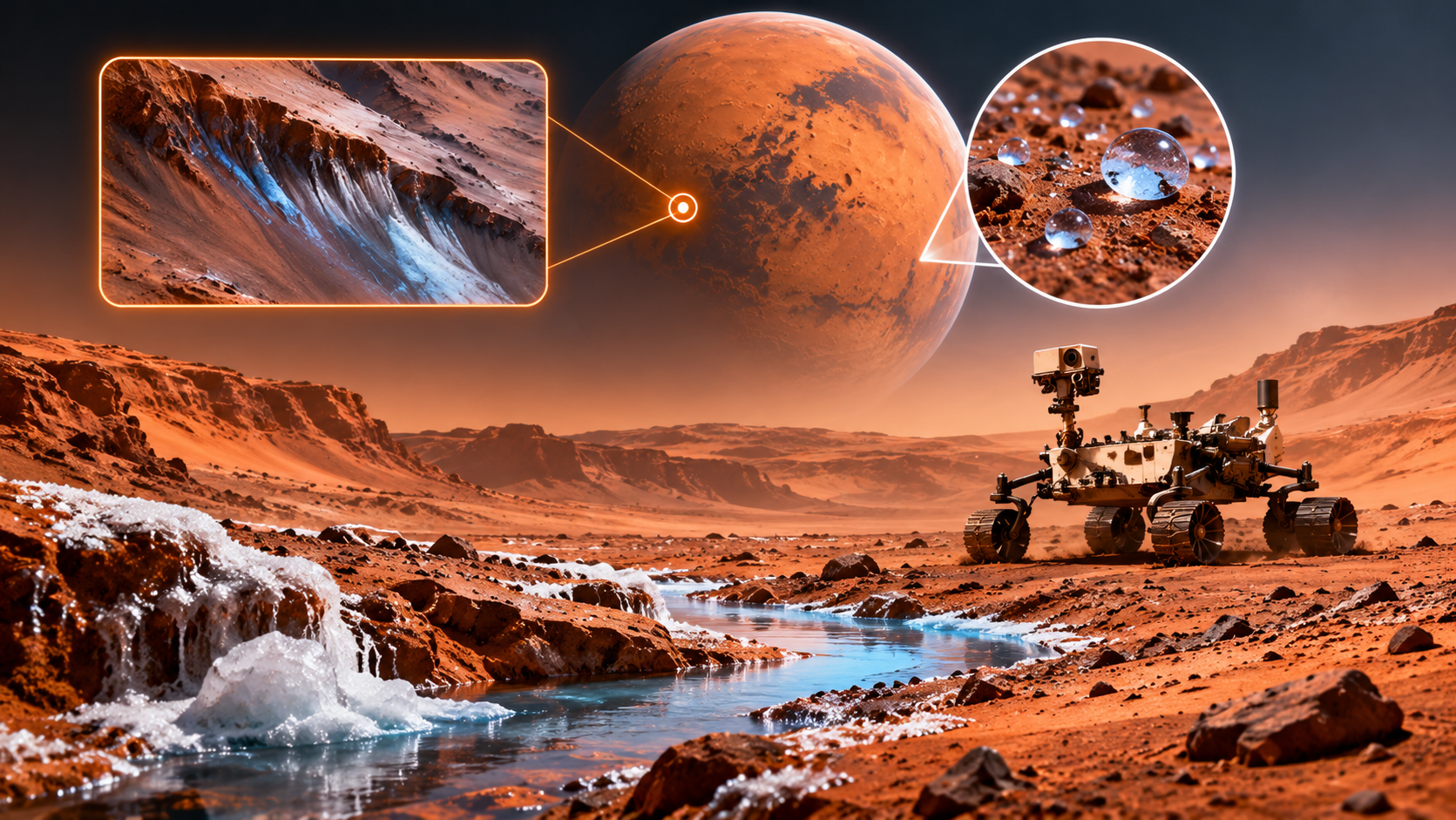
For perspective, we have not yet put humans on the nearest planet, where the practical questions are things like whether there is usable water on Mars. Those numbers explain the appeal of FTL travel better than any argument. Even the closest star is punishing. The Voyager probes — the most distant human objects ever built, launched in the 1970s — have not yet covered a thousandth of the distance to the nearest star.
What Physicists Actually Think
The honest consensus looks like this.
Travelling faster than light by conventional acceleration is considered genuinely impossible, not merely difficult. The evidence is overwhelming and the theory has survived every experimental challenge for over a century.
Warp drives and wormholes are not formally ruled out, which is a meaningful distinction — but they demand materials nobody has found, in quantities nobody can produce, with control nobody can describe. Most working physicists regard them as mathematical curiosities rather than engineering roadmaps.
Interstellar travel at a few percent of light speed is a hard engineering problem rather than an impossible one. That is the version most likely to happen, and the only one you could responsibly plan around.
And one caveat worth keeping. Relativity is extraordinarily well tested, but it does not reconcile cleanly with quantum mechanics. Whatever theory eventually unites them may reveal structure in spacetime that nobody has anticipated. That is not a reason for optimism about warp drives — but it is a reason to avoid the word "never" with too much confidence. Many of the instruments now probing these questions, including gravitational wave observatories, did not exist a generation ago.
Frequently Asked Questions About Faster-Than-Light Travel
Could humans ever travel faster than light?
Almost certainly not by accelerating a spacecraft, because that would require infinite energy. Theoretical loopholes such as warp drives and wormholes are not strictly forbidden by physics, but they depend on exotic matter with negative energy that has never been produced in usable amounts.
Why can nothing travel faster than light?
Because the speed of light is the maximum speed at which cause can produce effect. As an object with mass accelerates, its energy requirement rises without limit, reaching infinity at light speed. Exceeding it would also allow effects to precede their causes, breaking the logic of cause and effect.
Is the warp drive scientifically possible?
The mathematics is valid within general relativity. A warp drive would compress space ahead of a ship and expand it behind, moving space rather than the ship. The obstacle is that it requires negative energy density, which ordinary matter cannot supply, and nobody knows how to create, steer or stop such a bubble.
Does quantum entanglement allow faster-than-light communication?
No. Entangled particles influence each other instantly, but the outcome of each measurement is random and cannot be controlled. Both observers see random results until they compare notes through ordinary communication, which travels no faster than light.
How fast is the speed of light?
Approximately 300,000 kilometres per second, or about 1.08 billion kilometres per hour, in a vacuum. Light covers the distance from the Sun to Earth in roughly eight minutes.
What is the fastest humans have ever travelled?
Crewed spacecraft returning from the Moon reached roughly 39,000 kilometres per hour. Uncrewed probes have gone far faster, with solar missions exceeding 600,000 kilometres per hour — still well under one percent of light speed.
How long would it take to reach the nearest star?
With current propulsion, tens of thousands of years. At 20% of light speed, around 21 years. At 10%, roughly 43 years. The nearest star system lies about 4.2 light years away.
Are wormholes real?
No wormhole has ever been observed. General relativity permits such geometries mathematically, but a natural one would collapse almost instantly, and holding it open would require exotic matter that has never been found.
Does time slow down when you travel fast?
Yes. Time dilation is a measured effect, not a theory. Clocks on fast-moving spacecraft and satellites run measurably slower than clocks on the ground, and navigation systems must correct for it to stay accurate.
Could we reach another star without faster-than-light travel?
Yes, in principle. Fusion rockets, antimatter propulsion, laser-driven light sails and generation ships could all cross interstellar distances over decades or centuries. Time dilation would also shorten the journey considerably from the crew's perspective.
What is the Alcubierre drive?
It is the best-known theoretical warp drive concept. It describes a bubble of flat space carrying a ship, with space compressed in front and expanded behind. It is mathematically consistent but requires negative energy density that cannot currently be produced.
Is the expansion of the universe faster than light?
Beyond a certain distance, yes — galaxies recede from us faster than light. No rule is broken, because they are not moving through space quickly. Space itself is expanding between us, and the cosmic speed limit applies only to motion through space.
Will we ever have faster-than-light travel in the future?
Based on everything currently understood, no. Accelerating past light speed is considered genuinely impossible rather than merely difficult. Exotic alternatives remain mathematically open but face obstacles with no known solution. Realistic interstellar travel will almost certainly be slower than light.
The Verdict
Could humans ever travel faster than light? On the evidence, no — and the reason is worth sitting with. This is not a barrier awaiting a cleverer engine. It is woven into the structure of spacetime, and breaking it would mean effects preceding their causes.
Warp drives and wormholes survive on paper, which is genuinely interesting and genuinely insufficient. They need materials that may not exist in any usable form, and treating them as a roadmap confuses "not forbidden" with "achievable".
The realistic future is slower and stranger than fiction. Probes the size of a postage stamp, riding laser beams at a fifth of light speed. Fusion ships taking decades to cross to a neighbouring star. Crews for whom relativity bends the journey into something survivable, at the cost of never returning to the world they left.
It is not the galaxy-spanning empire of the films. But the stars are not closed to us — only expensive, slow, and one-way. That is a far more interesting answer than a warp drive would have been.


0 Comments