
Is There Really Water on Mars?
Mars holds far more water than most people realise — but almost all of it is frozen or locked inside rock. Here is exactly where it is, how we know, and whether any of…
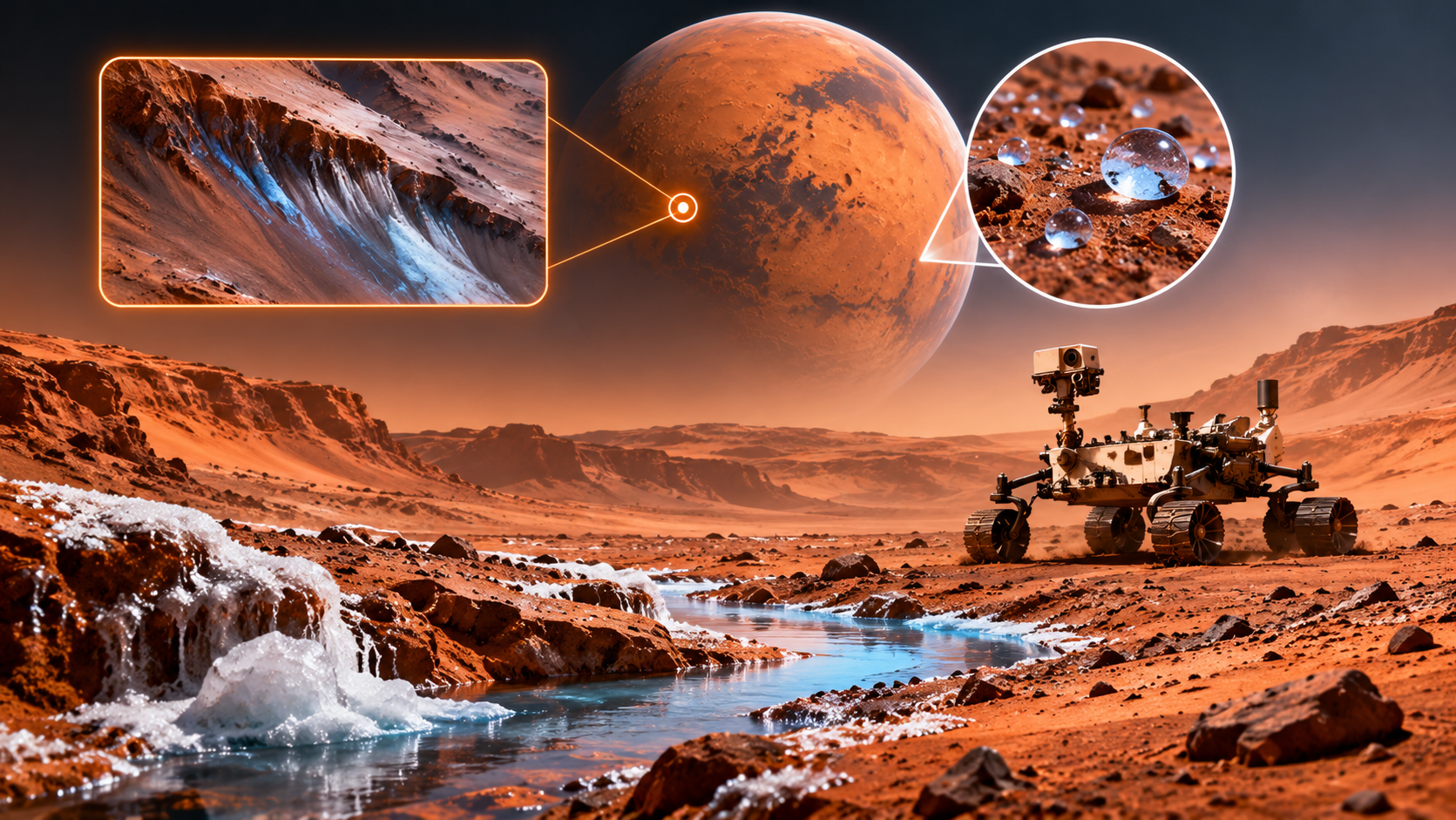
Ask most people whether there is water on Mars and you will get one of two answers: a confident "yes, they found it years ago," or an equally confident "no, it is a dead, dry desert." Both answers are wrong in interesting ways.
The short version is this: Mars has an enormous amount of water — far more than most people realise — but almost all of it is frozen solid or chemically locked inside rock. Whether any of it is liquid water on Mars today is one of the most genuinely contested questions in planetary science, and the answer has flipped more than once in the last twenty years.
This guide walks through exactly what has been found, where it sits, how we know, and what it means for the first humans who try to live there. No hype, no science-fiction shortcuts — just what the evidence actually supports, including the parts scientists still argue about.
The Short Answer: Yes, But Not the Kind You Can Drink
Is there water on Mars? Yes — definitively, and this is not speculation or a probability estimate. Spacecraft have photographed it, radar has mapped it underground, a lander physically scraped it out of the soil with a robotic arm, and rovers have driven across riverbeds that water carved billions of years ago.
But the water is not sitting in lakes or rivers waiting to be scooped up. It exists in three forms:
- Ice — at the poles and buried under huge areas of the mid-latitudes
- Hydrated minerals — water chemically bound inside clays, sulphates and salts
- Vapour — a trace amount drifting through the extremely thin atmosphere
What makes Mars so hostile to liquid water is not only the cold. It is the atmospheric pressure. Mars has roughly 0.6% of Earth's surface pressure — so low that pure liquid water cannot remain stable in the open. Expose it and it does not simply freeze or evaporate; it does both at once, boiling away while simultaneously turning to ice. That threshold is the single biggest reason Mars looks dry despite holding so much H₂O.
Where the Water on Mars Is Hiding
If you could gather every molecule of water on Mars and spread it evenly across the surface, you would get a global ocean somewhere between 20 and 30 metres deep. Here is where it actually sits.
The Polar Ice Caps
The most visible ice on Mars sits in the pair of bright white caps at the Martian north and south poles. These are not the dry-ice novelties they were once assumed to be. The northern cap in particular is overwhelmingly water ice — a stack roughly 2 kilometres thick and about 1,000 kilometres across, with only a thin seasonal veneer of frozen carbon dioxide that comes and goes with the seasons.
The southern cap is more complex: a permanent water-ice layer with a far more substantial carbon-dioxide cap sitting on top of it. Together the two polar caps hold the single largest known store of frozen water on Mars.
Radar instruments aboard orbiters have sliced through these caps layer by layer, revealing dust bands stacked like tree rings. Those layers are a climate archive, recording how Mars has wobbled on its axis over millions of years and shifted ice between the poles and the lower latitudes.
Buried Ice Across the Mid-Latitudes
This is the discovery that genuinely changed the picture, and it rarely gets the attention it deserves.
Mars is not dry between the poles. Vast regions of the mid-latitudes conceal sheets of buried ice under a protective blanket of dust and rubble, sometimes only a metre or two down. Ground-penetrating radar has traced ice deposits across areas larger than entire countries. In places, the ice is close to pure, with very little rock mixed in.
We have seen it directly. Fresh meteorite impacts regularly punch through the dusty surface layer and expose brilliant white ice at the bottom of new craters — ice that then slowly fades as it sublimates into the thin air. Steep slopes and eroding cliff faces in some regions show the ice in cross-section, layered like a glacier.
There are also features that look unmistakably like glaciers flowing down crater walls and around mountains, their shapes slowed and softened under insulating debris. Mars, it turns out, has something close to a buried cryosphere.
Water Locked Inside Rock
A third reservoir is easy to overlook because it does not look like water at all. Across much of the planet, orbiting spectrometers have detected hydrated minerals — clays, sulphates and other compounds that incorporate water molecules into their crystal structure.
These minerals only form in the presence of liquid water, so they are simultaneously a store of water and a fossil record proving water once flowed there. Heat the rock and the water comes back out, which is precisely why these deposits interest mission planners.
Vapour in the Atmosphere
Finally, alongside the ice on Mars there is a small amount of water vapour in the Martian atmosphere — enough to form thin clouds, morning fogs, and delicate frost that settles overnight and vanishes by mid-morning. In total it is a vanishingly small fraction of the planet's water, but it proves the system is active rather than frozen in place.
Is There Liquid Water on Mars Right Now?
This is where honest answers get more interesting than confident ones. The question of whether liquid water exists on Mars today has no settled answer, and anyone claiming otherwise is overselling the evidence.
The Brine Argument
Pure water cannot stay liquid at Martian surface conditions — but salty water is a different proposition. Martian soil is rich in perchlorates, salts that dramatically lower the freezing point of water. A sufficiently briny solution could, in principle, remain liquid at temperatures and pressures that would destroy pure water.
The likely result is not a puddle. It is something closer to a damp, salty film clinging to soil grains just under the surface, forming and disappearing with the temperature. Thin, transient, and nothing like a habitat as we normally picture one.
The Streaks That Fooled Almost Everyone
For a while, it looked settled. Dark streaks called recurring slope lineae appear on steep Martian slopes during warm seasons, extend downhill, then fade when temperatures drop. They were widely reported as flowing briny water, and the announcement made headlines worldwide.
Further study complicated that story considerably. The streaks behave in ways that fit dry granular flows — fine sand and dust slipping downhill — at least as well as they fit water. They appear at angles close to the natural slope at which loose sand avalanches. Many researchers now consider them most likely dry, or at best only marginally damp.
It is a useful reminder: on Mars, evidence that looks conclusive often is not, and the scientific consensus can reverse.
The Suspected Lake Beneath the South Pole
The boldest claim came from radar surveys of the south polar ice cap, which detected a bright reflection about 1.5 kilometres down — the kind of signal you would expect from liquid water trapped beneath a glacier, exactly as subglacial lakes behave in Antarctica.
If correct, it would mean a body of extremely salty liquid water sitting under the ice right now. The debate since has been fierce. Alternative explanations include layers of clay, frozen brines, or electrically conductive rock — all of which can produce a similar radar signature without any liquid at all. Modelling also suggests the location may simply be too cold for liquid water to persist without an unusual heat source.
The honest status: unresolved, and leaning sceptical.
Deep Groundwater in the Crust
The most intriguing possibility sits far below everything discussed so far. Analysis of seismic waves travelling through the Martian crust points to a zone of fractured rock saturated with liquid water, kilometres beneath the surface, where internal heat could keep it from freezing.
If that interpretation holds, it would be by far the largest reservoir of liquid water on Mars — potentially enough to account for much of the water the planet appears to have lost. It would also be entirely out of reach of current drilling technology, buried under kilometres of rock.
How We Know: The Evidence Behind the Headlines
The case for water on Mars does not rest on any single discovery. It is built from decades of independent measurements that all point the same way.
Orbiters and Radar Mapping
Spacecraft circling Mars have done most of the heavy lifting. NASA's Mars Odyssey mapped hydrogen concentrations in the top metre of soil and found enormous signatures near the poles — hydrogen being a reliable proxy for buried ice.
The Mars Reconnaissance Orbiter added high-resolution cameras sharp enough to photograph individual boulders, plus radar that profiles subsurface layers. Europe's Mars Express has been sounding the subsurface for two decades and produced the contested south-polar signal.
India's Mars Orbiter Mission contributed atmospheric measurements and made India the first country to reach Mars orbit on its first attempt — a result that reshaped expectations about what a lean planetary programme can achieve.
Landers That Touched the Ice
Orbital data is persuasive; physical contact is conclusive. A polar lander dug a shallow trench in the Martian soil and exposed bright material underneath. Over the following days, that material slowly disappeared — behaving exactly as water ice does when it sublimates, and ruling out salt or mineral deposits, which would simply have sat there.
That was the moment water on Mars stopped being an inference and became something a machine had physically touched.
Rovers Reading Ancient Riverbeds
The Curiosity rover has spent years inside Gale Crater, which once held a long-lived lake. It has driven over rounded pebbles — rounded the way river stones are rounded, by tumbling in flowing water — and drilled into fine mudstones that only form in standing water. Crucially, the chemistry it found describes water that was neither strongly acidic nor heavily salted. Drinkable, in principle, had anyone been there to drink it.
The Perseverance rover went further, landing in Jezero Crater at the mouth of an unmistakable river delta. Deltas form only where a river slows as it enters a standing body of water, dropping its sediment in a fan. Perseverance has been collecting samples there and sealing them in tubes for a future mission to retrieve.
Mars Was Once a Water World
Everything above describes Mars today. The deeper story is what Mars used to be.
Rivers, Deltas and Possible Shorelines
Orbital imagery has mapped thousands of dry river valleys branching across the Martian highlands in networks that look startlingly like drainage basins on Earth. There are deltas, alluvial fans, and features in the northern lowlands that some researchers interpret as the remains of ancient shorelines — hinting at a possible ocean on Mars covering much of the northern hemisphere.
The ocean hypothesis remains debated, largely because the proposed shorelines are not level in the way a true coastline should be. But the river valleys and deltas are not seriously disputed by anyone. Water flowed on the Martian surface, repeatedly and for long stretches of time.
How Much Water Did Mars Actually Have?
Estimates vary, but a common figure is a global layer somewhere between 100 and 1,500 metres deep, concentrated mainly in the northern lowlands. At the upper end, that is a genuine ocean.
The strongest evidence comes from measuring hydrogen in the remaining atmosphere. Water contains both ordinary hydrogen and a heavier form called deuterium. Lighter hydrogen escapes to space more easily, so a planet steadily losing water becomes progressively enriched in deuterium. Mars is heavily enriched — the clearest possible fingerprint of a planet that once held far more water than it does now.
Where Did It All Go?
Three things happened, and they compounded one another.
First, Mars lost its magnetic field early in its history. Earth's magnetic field deflects the solar wind; without one, Mars left its upper atmosphere exposed. The MAVEN orbiter has measured this erosion directly and watched it intensify during solar storms.
Second, Mars is small — about a tenth of Earth's mass — so its weaker gravity makes it far easier for light molecules to escape.
Third, a significant fraction never escaped at all. It was absorbed into the crust, chemically bound into hydrated minerals. That water is still there, locked in rock, effectively removed from circulation.
How Much Water Is on Mars Today?
| Reservoir | Form | Estimated scale | Reachable? |
|---|---|---|---|
| North polar cap | Water ice | Global layer ~20 m deep | Yes, but far from landing zones |
| South polar cap | Water ice under CO₂ | Global layer ~5–10 m | Harder — CO₂ overburden |
| Mid-latitude buried ice | Ice sheets and glaciers | Potentially tens of metres | Most promising for crews |
| Hydrated minerals | Chemically bound | Widespread, thin | Needs heating to extract |
| Deep crustal water | Possibly liquid | Possibly the largest of all | Kilometres down — not yet |
| Atmospheric vapour | Gas | Negligible | Technically, but barely worth it |
Could Water on Mars Support Life?
This is the question underneath every Mars mission, and it splits cleanly in two.
Past life is a reasonable scientific question. Ancient Mars had standing water, a thicker atmosphere, the right chemical ingredients and an energy supply — for hundreds of millions of years, while life was establishing itself on Earth. If life began on Earth under comparable conditions, Mars had a genuine opportunity. Whether it took that opportunity is exactly what the sealed sample tubes in Jezero Crater are meant to help answer.
Present-day life on the surface is far harder to argue for. Unfiltered ultraviolet radiation sterilises the top layer of soil, the perchlorates that keep brines liquid are also toxic to most familiar organisms, and liquid water — if present at all — is thin, fleeting and extremely salty.
The more defensible possibility is deep underground, shielded from radiation, warmed by internal heat, where any liquid water would be stable rather than transient. On Earth, microbial communities thrive kilometres below the surface with no sunlight whatsoever. Nothing rules out an equivalent on Mars — but nothing demonstrates it either.
Why Water on Mars Matters for Astronauts
Beyond the science, there is a brutally practical reason this question commands so much attention: water is the single heaviest thing you would otherwise have to carry.
Launching anything to Mars costs enormously per kilogram, and a crew needs water continuously. Finding it locally changes mission design completely, because water delivers four things at once:
- Drinking water, after filtering out perchlorates
- Breathable oxygen, split out electrically
- Rocket fuel — hydrogen from that same split, for the journey home
- Radiation shielding — water is excellent at absorbing cosmic rays
This is why in-situ resource utilisation dominates landing-site selection. The ideal site needs shallow accessible ice, a latitude survivable for humans, and terrain flat enough to land on. Those three requirements conflict — the richest ice sits near the poles, where sunlight is scarce and conditions are brutal. Mapping efforts like the subsurface ice mapping project exist specifically to resolve that trade-off.
The same logic drives resource planning elsewhere in the solar system — it is the reasoning behind efforts to work out how humans will get electricity on the Moon, and why India's Chandrayaan-3 mission targeted the lunar south pole, where water ice is thought to survive in permanently shadowed craters.
Five Myths About Water on Mars
"They found a lake on Mars, so it's settled." The radar signal is real; the interpretation is contested. Clays and frozen brines can produce the same reading.
"The dark streaks are flowing water." That was the early reading. Dry sand flows now explain the behaviour at least as well.
"Mars is completely dry." Comprehensively false. There is enough ice to bury the planet metres deep.
"Astronauts could just melt ice and drink it." Not directly. Martian soil contains perchlorates, which are toxic and would need removing first.
"Water on Mars means life on Mars." Water is necessary, not sufficient. Finding water raises the question; it does not answer it.
What Comes Next
Several threads will sharpen the picture over the coming decade. Sample return is the big one — the tubes Perseverance has filled contain delta sediments, precisely the material most likely to preserve traces of ancient life, and laboratory instruments on Earth vastly outperform anything a rover can carry.
Alongside that, drilling missions aim to reach a couple of metres down, below the sterilising radiation layer, where organic molecules stand a better chance of survival. Improved orbital radar is steadily refining the buried ice maps that future crews will depend on. And ongoing seismic work may yet confirm or rule out the deep groundwater interpretation.
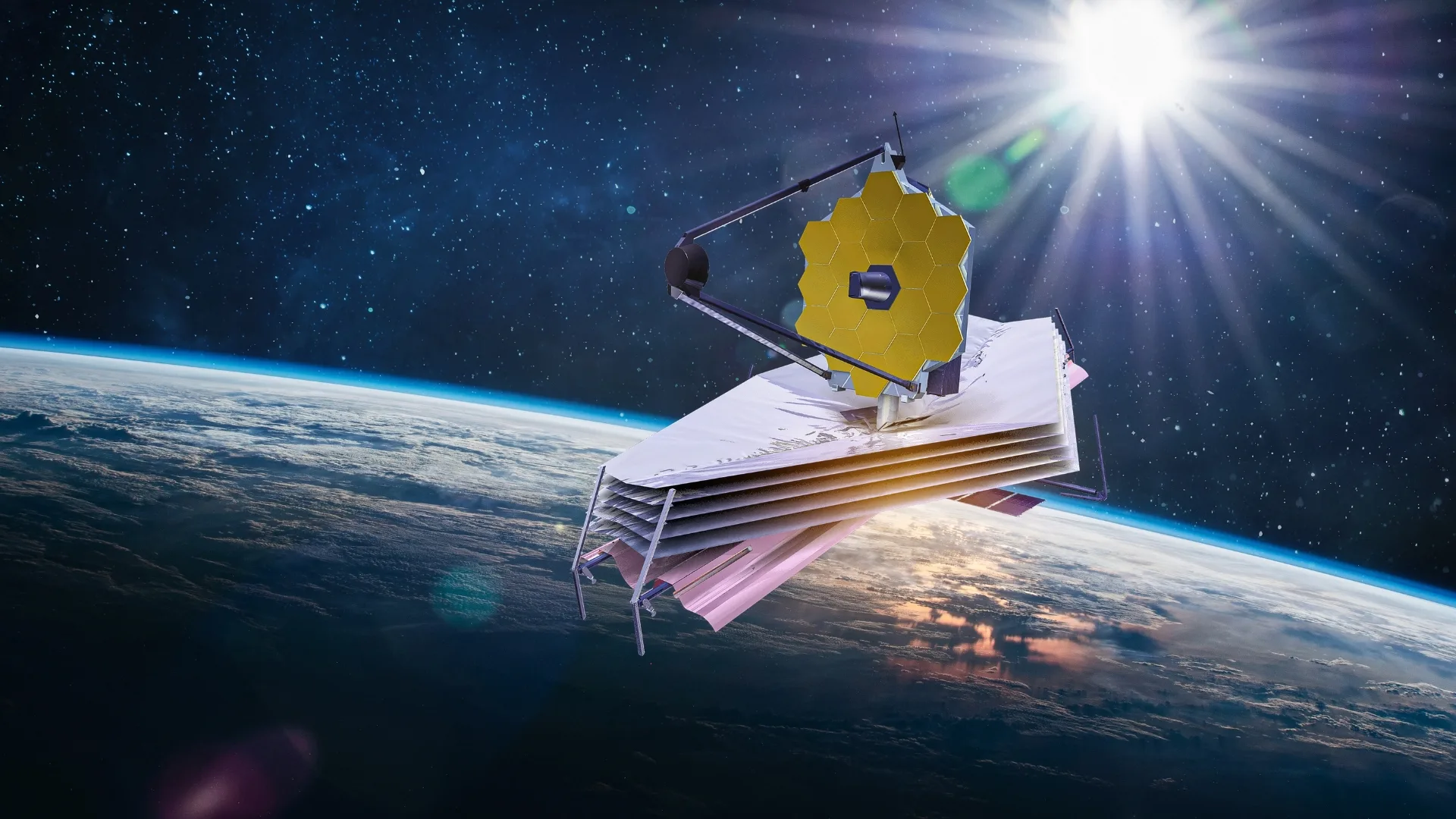
The trajectory of Mars exploration has been consistent: each generation of instruments finds more water than the last, in more places, and reveals the planet's history to be wetter and more complex than previously assumed. Whether that trend ends at "frozen and lifeless" or somewhere more interesting is still genuinely open — which is precisely what makes it worth following. For more on how robotic explorers are built for these conditions, see our look at a rugged Mars rover concept, and for the wider picture of what we are learning about the universe, the James Webb Space Telescope has been rewriting assumptions of its own.
Frequently Asked Questions About Water on Mars
Is there really water on Mars?
Yes. There is a large and confirmed quantity of water on Mars, almost all of it frozen as ice at the polar caps and buried beneath the mid-latitudes, plus a significant amount chemically bound inside minerals. Spacecraft have imaged it, radar has mapped it, and a lander physically exposed ice in the soil.
Does Mars have water today?
Yes. Mars has water today in the form of polar ice caps, extensive buried ice across the mid-latitudes, water bound inside minerals, and a trace of vapour in the atmosphere. What Mars does not have is stable liquid water sitting openly on its surface.
Is there liquid water on Mars right now?
Possibly, but it is not confirmed. Pure liquid water cannot remain stable at the surface because the atmospheric pressure is too low. Very salty brines might persist briefly in soil, a disputed radar signal hints at liquid under the south polar cap, and seismic data suggests liquid water may exist kilometres down in the crust.
How much water is on Mars?
Enough to cover the entire planet in a layer roughly 20 to 30 metres deep if melted and spread evenly. Ancient Mars is estimated to have held far more — possibly a layer hundreds of metres deep, concentrated in the northern lowlands.
Can you drink water on Mars?
Not without processing it. Martian ice is water, but the surrounding soil contains perchlorate salts that are toxic to humans. Any water extracted for a crew would need filtering and treatment before it was safe to drink.
Why did Mars lose its water?
Mars lost its global magnetic field early in its history, leaving the atmosphere exposed to the solar wind, which stripped it away over billions of years. Its low gravity made escape easier still, and a large share of the remaining water was absorbed into the crust as hydrated minerals.
Did Mars have oceans?
Probably, though it remains debated. Dry river valleys, deltas and sedimentary rocks prove surface water flowed repeatedly. Features in the northern lowlands may be ancient shorelines, but they are not level in the way a true coastline should be, so the ocean hypothesis is not settled.
Does water on Mars mean there is life on Mars?
No. Water is necessary for life as we know it, but not sufficient. Ancient Mars had conditions that could plausibly have supported microbial life, and that possibility is being actively investigated — but no evidence of life, past or present, has been found.
Where is the water on Mars located?
Mostly at the two polar ice caps, in buried ice sheets and glacier-like deposits across the mid-latitudes, and locked inside hydrated minerals spread widely across the surface. A small amount exists as vapour in the atmosphere, and possibly far more as liquid deep in the crust.
What are the dark streaks on Martian slopes?
Known as recurring slope lineae, they are dark marks that appear on steep slopes in warm seasons and fade in cold ones. They were initially reported as flowing brine, but later analysis suggests dry flows of sand and dust explain them at least as well.
Could astronauts use the water on Mars?
That is the plan. Buried ice could supply drinking water, breathable oxygen, hydrogen for rocket fuel and radiation shielding — which is why accessible ice is a primary factor in choosing landing sites for crewed missions.
Is there ice on the surface of Mars?
Yes. The polar caps are visible from orbit, seasonal frost forms and vanishes in many regions, and fresh meteorite impacts regularly expose bright white ice just beneath the dusty surface layer.
Will humans find more water on Mars?
Almost certainly. Every generation of instruments has found more water in more places than the one before. Improved radar mapping, deeper drilling and returned samples are all expected to refine the picture further.
The Verdict
So, is there really water on Mars? Yes — a great deal of it, and the evidence is overwhelming rather than marginal. Mars is not the bone-dry rock of older textbooks. It is a frozen world holding ice at its poles, glaciers under its dust, water bound inside its rocks, and quite possibly liquid water kilometres beneath its surface.
What Mars no longer has is accessible, stable, liquid surface water — the rivers, lakes and seas it demonstrably had billions of years ago. That water did not vanish so much as freeze, sink, bind into rock and leak away into space, leaving behind dry channels and deltas that still trace where it ran.
For anyone planning to go there, the practical answer is the encouraging one: the water is present, it is abundant, and much of it is reachable with a shovel rather than a drill rig. The scientific question — whether anything ever lived in it — is still wide open, and that is exactly why Mars remains the most closely watched planet in the solar system.




0 Comments