
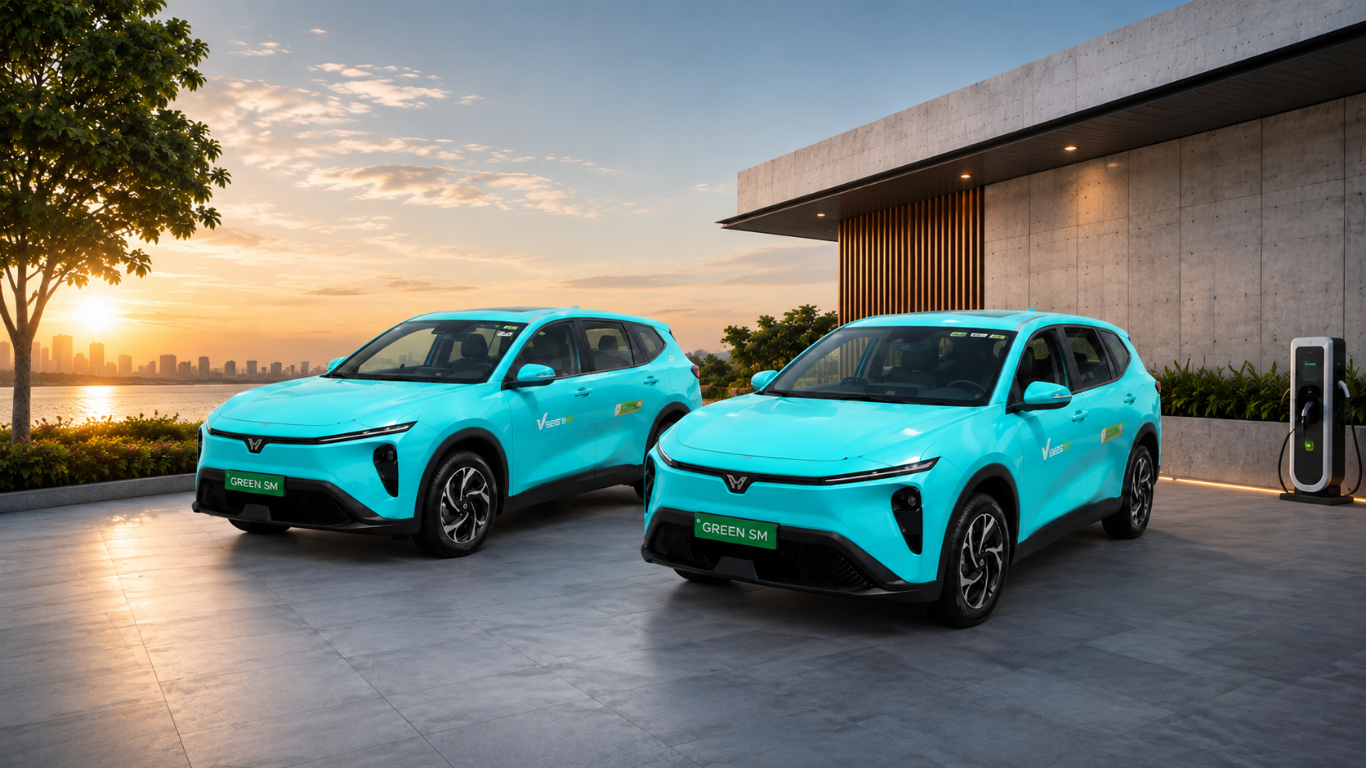
On June 5, 2026 — World Environment Day — Vietnamese electric vehicle giant VinFast did something no international automaker had attempted in India before. It did not just launch a car. It launched a taxi service. The Green SM electric cab service went live in Delhi-NCR with a fully company-owned and company-managed fleet of VinFast electric vehicles, fares starting at ₹8 per kilometre, and a headline promise that every Indian commuter has waited years to hear from any cab company: zero surge pricing — ever.
India’s ride-hailing market is dominated by Ola and Uber, with Rapido gaining ground fast in the two-wheeler and auto segment. Together, they process tens of millions of trips daily — but have also accumulated a long list of consumer complaints: unpredictable surge pricing, driver cancellations, inconsistent vehicle quality, and a race-to-the-bottom driver income model that benefits nobody long-term. VinFast’s Green SM is positioning itself as the answer to all of these — with a fleet-owned, professionally managed model that the company has already successfully deployed across Vietnam, Indonesia, Laos, and the Philippines.
Is it genuinely different? Can it compete? And what does it mean for the everyday Indian commuter? Here is everything you need to know about VinFast’s electric taxi in India — and an honest comparison against Ola, Uber, and Rapido.
VinFast Green SM India — Quick Facts
| Detail | Information |
| Service Name | Green SM (Green Smart Mobility) |
| Parent Company | Vingroup (parent of VinFast) |
| Launch Date | June 5, 2026 (World Environment Day) |
| Launch City | Delhi-NCR (Delhi, Gurugram, Noida) |
| Next Cities | Bengaluru, Hyderabad (planned) |
| Starting Fare | ₹8 per kilometre (introductory) |
| Surge Pricing | ❌ None — zero surge policy |
| Fleet Type | 100% company-owned EV fleet |
| Vehicles Used | VinFast VF 5 + VinFast Limo Green (7-seater MPV) |
| Initial Fleet | ~1,000 vehicles (Delhi-NCR launch) |
| Target Fleet | 15,000 vehicles (within 7 months) |
| Driver Model | Company-trained professionals, not gig aggregators |
| App | Green SM app (Android + iOS) |
What Is VinFast Green SM? The Concept Explained
Green SM (Green Smart Mobility) is Vingroup’s electric mobility division — the same Vingroup that owns VinFast, VinHomes, and a portfolio of major Vietnamese conglomerates. Green SM is not a new experiment. The service already operates across Vietnam, Indonesia, Laos, and the Philippines, with Vietnam alone seeing the service deployed across dozens of cities. India is Green SM’s most ambitious international expansion to date — and the timing of the launch on World Environment Day was a deliberate signal about the brand’s positioning.
The core concept is fundamentally different from how Ola, Uber, and Rapido work. Rather than an aggregator model — where a technology platform connects independent drivers (who own or lease their own vehicles) with passengers — Green SM operates a fleet-owned, company-managed model. VinFast owns the cars. Vingroup trains and employs the drivers as professionals. The company directly manages maintenance, charging schedules, service standards, and pricing. There are no independent driver-partners making autonomous decisions about whether to accept a ride, cancel mid-trip, or demand a cash top-up.
This model has a direct implication for service consistency — and it is the central promise VinFast is making to Indian commuters who have grown frustrated with the unpredictability of app-based cab aggregators.
The VinFast Fleet: VF 5 and Limo Green Explained
The Green SM launch in Delhi-NCR deploys two specific VinFast electric vehicles, each targeting a different passenger need:
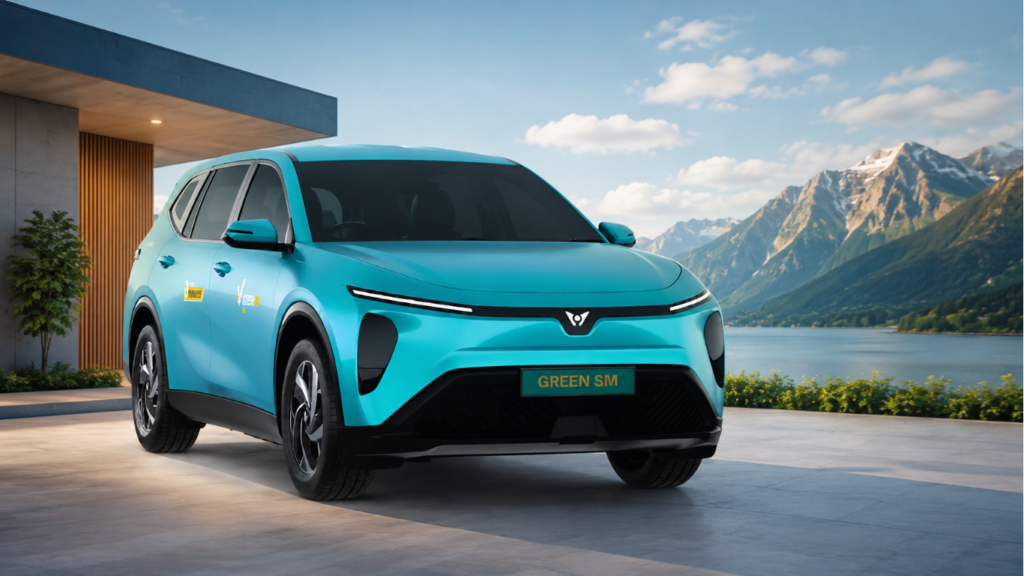
VinFast VF 5 — Standard City Commuter
The VinFast VF 5 is a compact electric crossover that serves as the everyday city commute vehicle in the Green SM fleet. For passengers, it means a premium cabin compared to the typical Wagon R, Alto, or Swift that powers most budget cabs in India. The VF 5 offers:
- Seating: 5 passengers comfortably
- Range: Approximately 326 km on a full charge (WLTP) — well suited for daily urban operations
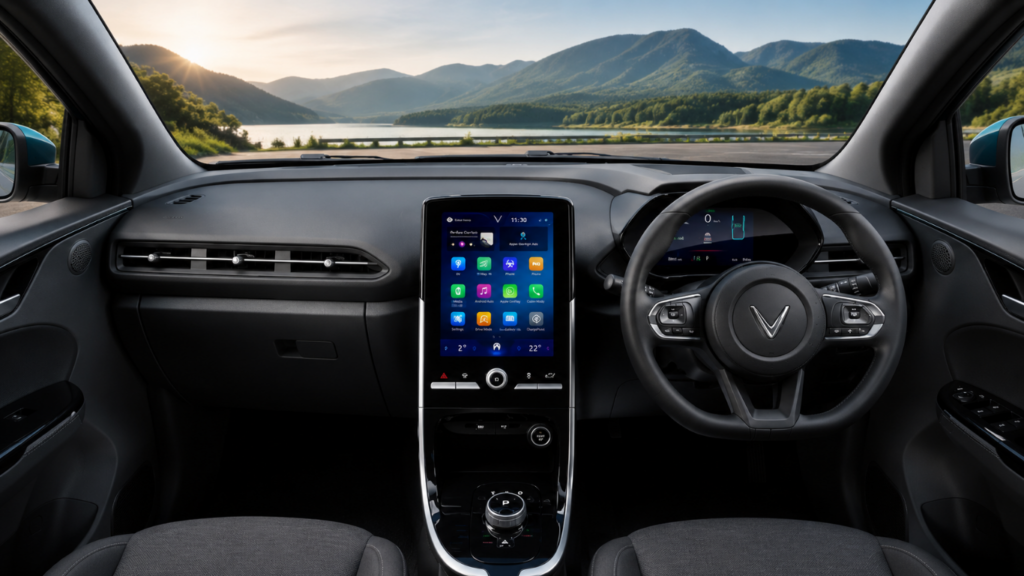
- Cabin: Dedicated climate control, clean interior, charging points for passengers
- Powertrain: Single electric motor, front-wheel drive — quiet and smooth urban ride
- Target use: Daily city commutes, office travel, short-distance rides
VinFast Limo Green (VF MPV 7) — Premium 7-Seater
The Limo Green — based on the VinFast VF MPV 7 that was formally launched in India at ₹24.49 lakh — is the more premium tier of Green SM’s fleet. A 7-seater fully electric SUV-MPV designed for:
- Seating: 7 passengers with generous legroom in all three rows
- Range: 517 km certified range — suitable for airport transfers and intercity routes
- Motor: 201 bhp electric motor
- Target use: Airport transfers, family travel, corporate rides, longer intercity routes
- Cabin: Premium 7-seat layout, USB-C charging ports, large panoramic roof
The two-tier fleet strategy mirrors what Green SM does in Vietnam — the compact VF 5 handles the high-volume short-trip urban market, while the Limo Green targets the premium airport and corporate segment where margins are higher and customer expectations are steeper.
VinFast Green SM Fares: What Will It Cost You?
The headline fare of ₹8 per kilometre is the most aggressive positioning in this launch — and it is deliberately designed to match, not undercut, the base rates of Ola and Uber. Here is the important distinction: while Ola and Uber start at similar per-km rates, both platforms routinely apply surge multipliers of 1.5x to 3x (sometimes more) during peak office hours, monsoon weather, event nights, and late-night travel. An ₹8/km Ola ride at 9 AM on a Monday in Gurugram frequently becomes a ₹18-24/km fare by the time surge is applied.
Green SM’s zero surge pricing policy means ₹8/km at 9 AM Monday, ₹8/km during the evening rush, ₹8/km during a thunderstorm, and ₹8/km on New Year’s Eve. The company has specifically committed to avoiding surge pricing during peak office hours and bad weather — the two scenarios where Indian commuters most frequently feel exploited by current ride-hailing platforms.
The expected fare structure breakdown (approximate, subject to final launch pricing):
| Fare Component | Green SM (Expected) |
| Base rate per km | ₹8/km (introductory) |
| Minimum fare | ₹60-80 (estimated) |
| Surge pricing | ❌ None |
| Peak hour premium | ❌ None |
| AC charges | Included |
| Limo Green premium | Higher than VF 5 tier |
VinFast Green SM vs Ola vs Uber vs Rapido — Full Comparison
| Feature | VinFast Green SM | Ola | Uber | Rapido |
| Model | Company-owned fleet | Aggregator | Aggregator | Aggregator |
| Base Fare | ~₹8/km | ₹7-10/km | ₹8-12/km | ₹4-6/km (bike) |
| Surge Pricing | ❌ Zero | ✅ Up to 3x | ✅ Up to 2.5x | ✅ Surge applicable |
| Vehicle Type | 100% EV (VinFast) | Mixed (petrol + CNG + EV) | Mixed (petrol + CNG + EV) | Bikes, autos, cabs |
| Vehicle Quality | Standardised (company-controlled) | Varies by driver | Varies by driver | Varies by driver |
| Driver Cancellation | Company policy — minimised | Common issue | Common issue | Common issue |
| AC Availability | Always included | Not guaranteed (Micro) | Not guaranteed (Go) | N/A (bikes) |
| Environment | 100% zero emission | Mixed | Mixed | Mixed |
| Emissions | Zero tailpipe | Varies | Varies | High (bikes) |
| Cities (India) | Delhi-NCR (+ Bengaluru/Hyd soon) | 200+ cities | 100+ cities | 150+ cities |
| Corporate Accounts | ✅ Yes (focus area) | ✅ Yes (Ola Business) | ✅ Yes (Uber for Business) | Limited |
| App Quality | New — Green SM app | Mature, feature-rich | Mature, feature-rich | Good, improving |
| Driver Training | Professionally employed | Self-employed gig | Self-employed gig | Self-employed gig |
What Makes VinFast Green SM Genuinely Different From Ola and Uber?
1. Zero Surge Pricing — The Game-Changer
This is Green SM’s single biggest differentiator and the one most likely to drive initial adoption. One major difference could be the absence of surge pricing during peak hours, making fares more predictable for passengers. Indian commuters in metros have an almost universal frustration with surge pricing — particularly during monsoons, office rush hours, and late nights when alternatives are limited and platforms know it. Green SM’s commitment to flat pricing regardless of demand conditions directly addresses this pain point. For corporate commuters specifically — who travel at fixed times regardless of pricing — this predictability is worth a meaningful premium.
2. No Driver Cancellations — The Second Biggest Win
Driver cancellations on Ola and Uber are India’s most complained-about ride-hailing problem. A driver accepts a ride, then calls asking where you are going, then cancels if the destination or route is not to their liking. This is effectively impossible in a company-managed fleet model. Because drivers are trained professionals operating company-owned vehicles, the prevalent issue of drivers demanding drop locations and abruptly canceling rides is effectively eliminated. Drivers who cancel without valid operational reason answer to an employer rather than to a gig platform’s rating algorithm — a fundamentally different accountability structure.
3. Standardised, Premium Vehicle Quality
Book an Ola Micro and you might get a clean, well-maintained Swift — or a 2017 Alto with broken AC and torn seat covers. The aggregator model has no practical way to enforce vehicle quality standards. Green SM owns every car in its fleet and directly manages maintenance schedules, cleanliness standards, and charging protocols. Every VinFast VF 5 you book will have functioning AC, charged seats, clean upholstery, and a driver in uniform — because the company bears the direct cost and reputational consequence if they do not.
4. 100% Electric — Real Environmental Benefit
Ola and Uber have made EV commitments, but their actual fleet remains predominantly petrol and CNG because they cannot control what vehicles their driver-partners purchase. Green SM’s fleet is 100% electric by design — not by aspiration. Every Green SM ride produces zero tailpipe emissions. In Delhi-NCR, where vehicular air pollution is a genuine public health crisis, this distinction matters beyond marketing. As we covered in our analysis of why India is pushing EVs so hard in 2026, the government’s own electric mobility targets make all-EV taxi fleets like Green SM directly aligned with national policy — which means potential regulatory benefits and priority infrastructure access going forward.
5. Green SM as VinFast’s Marketing Engine
There is a strategic layer beyond the taxi service itself that is worth understanding. For VinFast, deploying Green SM is about more than capturing ride-hailing revenue — it is a massive, moving product demonstration. Before VinFast can sell retail cars to Indian consumers at scale, it needs to build brand trust. India’s car buyers are conservative, brand-conscious, and deeply sceptical of new entrants — particularly from markets they associate with lower quality. By putting tens of thousands of VinFast cars in front of Indian consumers as their daily commute vehicle first, VinFast is effectively running a continuous nationwide test drive. Every commuter who has a positive Green SM experience is a potential future VinFast car buyer.
Where Can You Book Green SM Right Now?
As of July 2026, Green SM is live in:
- Delhi — city-wide coverage expanding progressively
- Gurugram (Gurgaon) — corporate and residential areas
- Noida — Delhi-NCR tech corridor
Next cities in the confirmed pipeline:
- Bengaluru — high-income tech corridor, corporate commuter density
- Hyderabad — IT corridor, strong EV adoption
- Additional metro cities expected through 2026-2027
To book a Green SM cab, download the Green SM app from the Google Play Store or Apple App Store. The app is new and still building its feature set compared to the mature Ola and Uber apps, so expect some rough edges in the early months of operation.
Challenges VinFast Green SM Will Face in India
Green SM’s India launch is compelling on paper — but the ride-hailing market is one of the hardest competitive arenas in the country, and several real challenges stand between VinFast’s ambitions and execution.
1. Scale — 1,000 Cars vs Millions of Trips
Delhi-NCR alone processes several million ride-hailing trips every day. The initial fleet of 1,000 vehicles is a tiny fraction of what would be needed for meaningful market penetration. The 15,000-vehicle target within 7 months is ambitious — requiring rapid driver hiring, training, vehicle deployment, and charging infrastructure rollout simultaneously.
2. Charging Infrastructure
Unlike a private EV owner who charges overnight at home, a fleet vehicle needs to charge frequently and efficiently during operational hours to maintain utilisation rates. Delhi-NCR’s public charging infrastructure, while improving, is not yet at the density needed for a large fleet to operate without downtime. Green SM will need to build or contract its own charging network — a significant capital and logistics investment.
3. App Maturity
Ola and Uber have spent years and billions refining their apps — route optimisation, payment integration, driver tracking, emergency features, and customer support are all mature. The Green SM app is new. Early reviews will determine whether app quality becomes a barrier to adoption among users accustomed to the polish of established platforms.
4. Brand Trust
VinFast is still an unfamiliar name to most Indian consumers. Vietnamese brands do not carry the automatic credibility of Korean, Japanese, or European brands in India’s car market. Green SM’s fleet-as-product-demo strategy is precisely designed to address this — but brand trust takes time, and early operational issues will be scrutinised heavily by a media and consumer base watching a new entrant closely.
Who Should Switch to VinFast Green SM?
- Corporate commuters in Delhi-NCR — predictable daily fares without surge anxiety, professional drivers, consistent AC quality
- Office travellers during peak hours — the people who suffer most from surge pricing will benefit most from its absence
- Airport travellers — the Limo Green 7-seater with 517 km range is an excellent airport transfer vehicle, especially for families travelling with luggage
- Environmentally conscious commuters — every Green SM ride is zero tailpipe emission, tracked and verifiable
- Corporate accounts — businesses managing employee transportation budgets benefit enormously from predictable, non-surge pricing and professional driver standards
VinFast in India Beyond Taxis: The Bigger Picture
The Green SM launch is part of a much larger VinFast India strategy. The company currently offers three cars in the Indian retail market — the VinFast VF6 (₹18.19 lakh), VF7 (₹22.99 lakh), and VF MPV 7 (₹24.49 lakh). It has a manufacturing facility planned in Tamil Nadu that would enable local production — dramatically reducing import costs and potentially pushing retail prices significantly lower. For a deeper understanding of how India’s EV market is evolving and what it means for buyers, our guide to the best EV cars in India 2026 covers the full landscape. And our analysis of the best electric scooters under ₹1 lakh in India rounds out the picture for two-wheeler buyers looking at the EV transition.
Frequently Asked Questions
Q1. What is VinFast Green SM taxi service in India?
Green SM (Green Smart Mobility) is VinFast’s all-electric, company-owned taxi service launched in India on June 5, 2026. Unlike Ola and Uber which are aggregator platforms, Green SM owns every vehicle in its fleet and employs its drivers as trained professionals. It started operations in Delhi-NCR with fares from ₹8/km and a zero surge pricing policy.
Q2. What is the fare for VinFast Green SM taxi in India?
Green SM’s introductory fare starts at approximately ₹8 per kilometre — similar to Ola and Uber base rates. The key difference is that Green SM does not apply surge pricing at any time, including during peak office hours, bad weather, or high-demand periods.
Q3. Where is VinFast Green SM available in India?
Green SM is currently live in Delhi-NCR (Delhi, Gurugram, Noida). Bengaluru and Hyderabad are the confirmed next cities in the expansion plan. More metro cities are expected through 2026-2027.
Q4. Which vehicles does VinFast Green SM use in India?
Green SM’s India fleet uses two VinFast electric vehicles: the VinFast VF 5 (compact 5-seater for daily city commutes) and the VinFast Limo Green (7-seater electric MPV for airport transfers and premium rides).
Q5. Is Green SM cheaper than Ola and Uber?
At base rates, Green SM is roughly similar to Ola and Uber (~₹8/km). The real cost advantage comes from no surge pricing — during peak hours, Green SM can be 30-70% cheaper than a surged Ola or Uber fare for the same journey.
Q6. Does VinFast Green SM charge extra during peak hours?
No. Green SM has committed to zero surge pricing at all times, including peak office hours and bad weather — the two scenarios where Ola and Uber most commonly apply surge multipliers.
Q7. How do I book a VinFast Green SM cab?
Download the Green SM app from the Google Play Store or Apple App Store, register with your mobile number, and book directly through the app. The service is currently limited to the Delhi-NCR coverage area.
Q8. How many VinFast electric taxis will be deployed in India?
Green SM started with approximately 1,000 electric taxis in Delhi-NCR and has announced plans to scale to 15,000 vehicles across India within seven months of the launch.
Q9. Is VinFast Green SM safe to ride?
Green SM uses company-owned vehicles with company-trained, professionally employed drivers — a model that allows tighter safety oversight than gig aggregator platforms. All VinFast vehicles in the fleet are brand-new electric vehicles with modern safety features.
Q10. Will VinFast Green SM expand beyond Delhi to Mumbai and Chennai?
Bengaluru and Hyderabad are the confirmed next cities after Delhi-NCR. Mumbai, Chennai, and Pune are likely targets given the density and corporate commuter population, but no official dates have been announced for these cities yet.
Q11. How does Green SM compare to Ola Electric cabs?
Ola’s electric cab offering uses the aggregator model with independent driver-partners who may or may not have EVs, and surge pricing still applies. Green SM guarantees 100% EV fleet, zero surge, and standardised driver quality as part of the company-managed model — making it structurally more consistent than Ola’s electric cab category even where both use EVs.
Q12. What is VinFast’s plan for manufacturing in India?
VinFast has announced plans for a manufacturing facility in Tamil Nadu. Local manufacturing would significantly reduce import duties and allow VinFast to price both retail vehicles and fleet vehicles more competitively — potentially making the Green SM service and VinFast cars more affordable as this facility comes online.
Final Verdict: Is VinFast Green SM a Real Threat to Ola and Uber?
In its current form — 1,000 cars in Delhi-NCR — Green SM is not yet a threat to Ola or Uber. But its model is structurally superior in several important ways that matter deeply to Indian commuters: no surge pricing, no driver cancellations, standardised vehicle quality, and 100% electric. If VinFast executes its 15,000-vehicle target and maintains service quality during rapid scaling — both significant operational challenges — it has a genuine shot at carving out a meaningful premium segment in India’s ride-hailing market.
The most interesting long-term play is not even the taxi revenue. It is the brand building. Every Indian commuter who rides a clean, quiet, comfortable VinFast VF 5 to work and back is one step closer to considering a VinFast VF6 for their next car purchase. In a country where consumers are deeply conservative about new brands, that daily touch point is worth more than any amount of advertising. VinFast is not just launching a taxi service — it is launching India’s largest test drive programme, at scale, in the country’s most important metro markets.
Have you tried the Green SM taxi service in Delhi-NCR yet? Tell us your experience in the comments below.
*Information in this article is based on VinFast and Green SM official announcements and media coverage as of July 2026. Fleet size, city availability, and fare structures are subject to change as Green SM scales its India operations.