
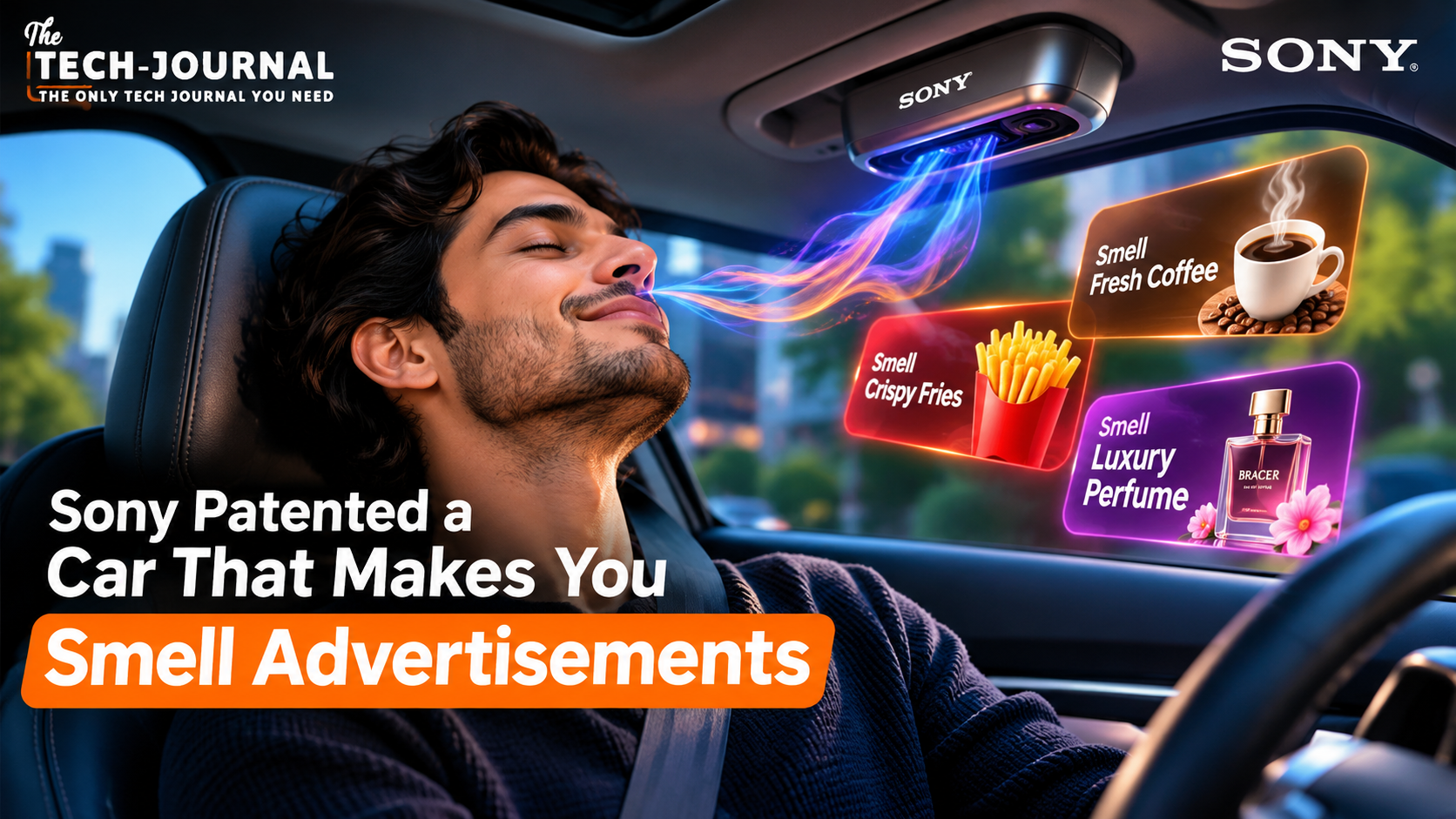
Sony Patented a Car That Makes You Smell Advertisements — Here's What the Patent Actually Says
Sony really did patent a system that releases scents matching the advertisements you drive past. We read the patent documents — and found the detail everyone else missed: a second camera, pointed at you.
Key Facts (verified against the patent itself):
- The patent is real. Sony Group Corporation, "Fragrance Control Device, Fragrance Control Method and Program"
- Filed 26 June 2020 — published 2022, granted in Japan in December 2024. This is not new
- A vehicle exterior camera detects the advertisement; a fragrance is then selected to match it
- It also covers ads on your phone, radio or infotainment screen — not just billboards
- The detail the headlines missed: an interior camera analyses the occupant’s profile and picks a scent for that specific person
- Assignee is Sony Group Corporation, not Sony Honda Mobility — this is not an Afeela feature announcement
A story has been circulating that Sony has patented a system which lets your car pump the smell of a burger into the cabin when you drive past a burger billboard. It sounds like satire.
It is not. We pulled the patent documents and read them. The system is real, the claims are broader than the headlines suggest, and the most interesting part of it has gone almost entirely unreported.
Here is what Sony actually filed, what it would do, why it probably will not reach your car, and the questions it raises about scent advertising, driver safety and in-cabin surveillance.
What the Patent Actually Says
The documents
There are two related filings in the same family, both assigned to Sony Group Corporation:
- "Fragrance Control Device, Fragrance Control Method and Program" — published as DE112020003549T5, filed 26 June 2020, published 19 May 2022. Granted in Japan as JP7597030B2 in December 2024.
- "Odor Output Control Device, Odor Output Control System and Method and Program" — published as DE112020003717T5, filed 7 July 2020. This sibling adds GPS and position data to the picture.
Between them, the documents mention "advertisement" over 350 times and "vehicle" more than 300 times. This is not an incidental use case buried in a general-purpose filing. Advertising is the point.
The core claim, in Sony’s own words
The central mechanism is stated plainly:
"...the scent output control unit selects a scent to be emitted based on an advertisement and outputs the selected scent through the scent output unit."
That is the whole idea in one sentence. An advertisement goes in; a smell comes out.
Where the advertisement comes from
This is where it gets broader than the headlines suggested:
"The fragrance emission control unit selects a fragrance to be emitted based on an advertisement detected from a photographic image by a vehicle exterior camera capturing an image outside the vehicle, or an advertisement issued to an information output terminal..."
Two separate input paths, then. An outward-facing camera reads billboards, shop signage and posters as you drive past. And an "information output terminal" — which covers a phone, the radio, or the infotainment screen — supplies the ad directly. The second path does not require the car to see anything at all.
The part almost nobody reported
Buried in the same document is a line that changes the character of the whole thing:
"Furthermore, an occupant’s profile is analyzed based on an image of the occupant, and a scent according to the occupant is emitted."
So there is a second camera, pointed inward. It looks at who is sitting in the seat, builds a profile of that person, and selects the scent accordingly. Combined with the per-seat emission the patent also describes, that means two people in the same car could be targeted with different advertising smells based on what a camera inferred about each of them.
In-cabin cameras are not speculative — they are already shipping as driver and occupant monitoring systems for drowsiness and attention detection. The patent proposes pointing that existing hardware at a different problem.
This Is Not News — It Was Filed in 2020
Worth stating clearly, because nearly every version of this story presents it as a fresh development.
The application was filed in June 2020. It was published in 2022. The Japanese patent was granted in December 2024. Nothing happened in the past few weeks except that someone noticed.
This is the normal life cycle of a patent story. Applications sit unread in public databases for years until an aggregator surfaces one, at which point it is reported as though the company announced it yesterday. Sony has not announced anything. It filed a patent more than five years ago.
How the System Would Work
Reading the claims together, the described pipeline has four stages.
1. Detect
The outward camera captures the scene ahead. Image recognition identifies that a billboard or sign is present and works out what it is advertising. The sibling patent adds GPS and position information, which would let the car know it is passing a particular restaurant rather than merely seeing a picture of food.
2. Match
The identified product is mapped to a fragrance from a finite set the car physically carries — coffee, baked goods, citrus, floral, and so on. There is no synthesising of arbitrary smells. A cartridge system holds a handful of scents, and the software picks the closest match.
3. Emit
A scent output unit releases the fragrance into the cabin, controlled for intensity and duration.
4. Target
Using the interior camera and seat-level emission, the scent can be directed at a specific occupant. The patent discusses occupants and seats extensively — this is per-person advertising, not a cabin-wide air freshener.
Why Smell? The Logic Behind Scent Advertising
The idea sounds absurd, but the commercial reasoning behind scent marketing is well established.
Smell reaches memory differently
Olfaction is anatomically unusual. Most senses route through the thalamus before reaching higher brain regions; smell connects more directly to the olfactory bulb, which sits close to the amygdala and hippocampus — structures associated with emotion and memory. This is the mechanism usually invoked to explain why a smell can trigger a vivid recollection more abruptly than a photograph.
Advertisers have wanted access to that channel for a long time.
It is already happening — just not in cars
Scent marketing is an established practice. Bakeries vent oven smells towards the pavement. Hotel chains diffuse signature fragrances in lobbies. Supermarkets position the bakery near the entrance. Some airlines scent their cabins.
What makes Sony’s filing different is not the use of smell. It is the automation, the targeting and the setting. A hotel lobby smells the same to everyone and you can walk out. A car is a sealed box you are strapped into, and the patent describes choosing the smell per passenger.
Will Sony Actually Build This?
What a patent is, and is not
Large technology companies file patents for several reasons, and "we are shipping this" is only one of them. Patents are also filed defensively, to prevent competitors from locking up an area; speculatively, to cover a direction that might matter later; and as negotiating assets in cross-licensing deals.
The overwhelming majority of patents never become products. A filing is evidence that engineers explored an idea and lawyers thought it worth protecting. It is not a product roadmap.
But Sony is genuinely in the car business
The caveat is that this is not a company dabbling. Sony makes the image sensors in a large share of the world's cameras, including automotive imaging systems, and has moved into vehicles directly through its joint venture with Honda.
The relevant point for this story: the assignee is Sony Group Corporation, not the Honda joint venture. This was filed by the parent company in 2020, before the car venture was announced. It is a research filing, not a product specification — and the broader shift toward software-defined vehicles is the context it belongs in.
The Problems With This Idea
Assume for a moment it did ship. The objections are not hypothetical.
You cannot close your nose
This is the fundamental one. You can look away from a billboard, mute a radio advertisement, scroll past a banner or install a blocker. There is no equivalent for smell. It arrives through involuntary breathing in an enclosed space you cannot leave while the car is moving. Every other advertising medium has an avoidance mechanism. This one does not.
Driver distraction
A sudden strong smell is a startle stimulus. Vehicle safety regulation has spent two decades constraining what may compete for a driver's attention — infotainment interfaces, notification behaviour, screen placement. An advertisement that triggers an involuntary physiological reaction while someone is driving at speed is a safety question before it is a marketing one.
Allergies, asthma and nausea
Fragrance sensitivity is common. Synthetic scents trigger migraines, asthma attacks and contact reactions in a meaningful share of the population. Motion sickness is aggravated by strong smells in moving vehicles, particularly for rear passengers and children. A system that emits scents automatically in a confined cabin would need medical opt-outs that the patent does not discuss.
The cabin is shared
A car typically carries more than one person. If the system directs a coffee advertisement at the driver while a passenger gets a perfume advertisement, both share the same air within seconds. Per-seat scent targeting assumes an airflow isolation that a real cabin does not provide.
Consent
Who agrees to this? The buyer of the car, once, in a settings menu they never revisit? Every passenger, every journey? A taxi passenger who did not choose the vehicle? The patent describes a mechanism, not a consent model — which is usual for patents and a significant gap for a product.
The Privacy Question Underneath
The scent is the attention-grabbing part. The data flow is the part that matters.
For the system to work as described, the car must continuously process video of the road ahead to identify advertisements, know its precise position, maintain a camera on the occupants and build a profile from their appearance, and reconcile that against a catalogue of advertisers and their fragrances.
That is a comprehensive picture of where you go, what you pass, who is with you, and how a system has categorised them. The commercial value of that data almost certainly exceeds the value of the smell. If such a system is ever built, the fragrance may be the least significant thing it produces.
It also fits an established pattern. Advertising measurement consistently migrates towards whatever channel is hardest for the user to observe or block — the same dynamic behind in-app tracking and the way ads follow you between websites. Readers who assume their devices are eavesdropping should read our piece on whether your smartphone is really listening to you: the real mechanisms are duller and considerably more effective.
Would It Be Legal in India?
Nothing in Indian law specifically addresses scent advertising in vehicles, because no regulator anticipated it. Several existing frameworks would apply, though.
- Data protection. Capturing and profiling occupants from in-cabin video is personal data processing, governed by the framework maintained by the Ministry of Electronics and IT. Profiling for advertising would require a consent basis.
- Vehicle safety rules. Anything that could distract a driver falls under motor vehicle regulation, and approval would not be automatic.
- Advertising standards. Indian advertising self-regulation covers misleading and intrusive advertising, though no code currently contemplates a medium you inhale.
The honest answer is that the law would have to catch up, and it would — the way it eventually did for pop-ups, autoplay video and unsolicited calls. Regulation of advertising formats has always lagged their invention.
Confirmed Versus Claimed
| Claim | Status | Detail |
|---|---|---|
| Sony filed a scent-advertising patent | Confirmed | DE112020003549T5, Sony Group Corporation |
| Exterior camera detects ads | Confirmed | Stated in the patent text |
| Matches ads on phone / radio / screen | Confirmed | "advertisement issued to an information output terminal" |
| Different scents for different passengers | Confirmed | Occupant profiling via interior camera |
| GPS is involved | Confirmed | In the sibling filing DE112020003717T5 |
| Burger ad triggers burger smell | Illustrative | A plausible example, not a quoted claim |
| Sony is building this | Not confirmed | No announcement; filed 2020 as research |
| It will appear in Afeela cars | Not confirmed | Assignee is Sony Group, not the Honda JV |
Frequently Asked Questions
Did Sony really patent a system that makes you smell advertisements?
Yes. Sony Group Corporation filed "Fragrance Control Device, Fragrance Control Method and Program", published as DE112020003549T5 and granted in Japan as JP7597030B2. The patent states that a scent output control unit "selects a scent to be emitted based on an advertisement". A related filing, DE112020003717T5, covers odour output using position data.
When was the Sony scent patent filed?
The main application was filed on 26 June 2020 and published in May 2022, with the Japanese patent granted in December 2024. Despite recent coverage presenting it as new, nothing has changed except that the filing was noticed. Sony has made no announcement about it.
How would the in-car scent advertising system work?
A camera facing outside the vehicle identifies an advertisement such as a billboard, or an advertisement is supplied directly by a phone, radio or infotainment screen. The system matches it to one of a limited set of fragrances the car physically carries, then releases that scent into the cabin. It can also direct different scents toward different seats.
Can the system target individual passengers?
Yes, according to the patent. It states that "an occupant’s profile is analyzed based on an image of the occupant, and a scent according to the occupant is emitted" — meaning an interior camera assesses who is in each seat and the fragrance is chosen for that person.
Is Sony actually going to build this?
There is no indication that it will. Large technology companies file patents defensively and speculatively as well as for products, and the overwhelming majority never ship. Sony has made no product announcement, and the filing predates its automotive joint venture with Honda.
Is this coming to the Sony Honda Afeela car?
Nothing suggests so. The assignee is Sony Group Corporation, the parent company, not Sony Honda Mobility. The application was filed in 2020, before the Afeela venture was unveiled, which indicates corporate research rather than a feature planned for a specific vehicle.
Why would advertisers want to use smell?
Because olfaction connects closely to brain regions associated with emotion and memory, which is why a smell can trigger a recollection more abruptly than an image. Scent marketing is already widespread — bakeries, hotel lobbies, retail stores and some airlines all use it. What is new here is the automation, the per-person targeting and the enclosed setting.
What is scent marketing?
The deliberate use of fragrance to influence mood, behaviour and brand recall. Common examples include hotels diffusing a signature scent in lobbies, supermarkets placing bakeries near entrances, and retailers scenting stores. It is an established practice; applying it automatically inside a moving vehicle is not.
Could you turn the scent advertising off?
The patent describes a mechanism rather than a consent model, so there is no stated answer. This is one of the strongest objections to the idea: unlike a visual or audio advertisement, a smell cannot be looked away from, muted or blocked, and a car cabin is an enclosed space an occupant cannot leave while travelling.
Is in-car scent advertising safe for drivers?
That has not been established and is a serious open question. A sudden strong smell is a startle stimulus, and vehicle safety regulation already constrains anything that competes for a driver’s attention. Fragrance sensitivity, asthma and motion sickness raise further concerns, particularly for passengers.
What are the privacy implications?
Substantial. The system as described requires continuous video analysis of the road, precise location tracking, an interior camera profiling occupants, and reconciliation against an advertiser catalogue. That produces a detailed record of where you go, what you pass and who travels with you — data whose commercial value likely exceeds that of the fragrance itself.
Would in-car scent advertising be legal in India?
No Indian law specifically addresses it, because no regulator anticipated it. Existing frameworks would apply: occupant profiling from in-cabin cameras is personal data processing under India’s data protection framework, driver distraction falls under motor vehicle safety rules, and advertising self-regulation covers intrusive advertising. The law would need to catch up, as it eventually did with pop-ups and unsolicited calls.
Conclusion
The story is true, the patent is real, and it is considerably more interesting than the version going around.
Sony did not simply patent a car air freshener that reacts to billboards. It described a system in which an outward camera reads advertising from the world, an inward camera decides who you are, and a scent is chosen for you specifically — with position data in the sibling filing to tell the car exactly what it is driving past.
It also filed this in June 2020 and has said nothing about it since, which is the strongest available evidence that it is research rather than a roadmap. Most patents are a record of a question someone asked, not a promise of a product.
What makes it worth paying attention to is not the likelihood of shipping. It is the direction. Every advertising medium so far has left the audience a way out — look away, mute, skip, block. A smell released into a sealed cabin removes that option entirely, and that is a line worth noticing before anyone crosses it rather than afterwards.
For now, the burger you smell while driving is still coming from an actual burger.


0 Comments