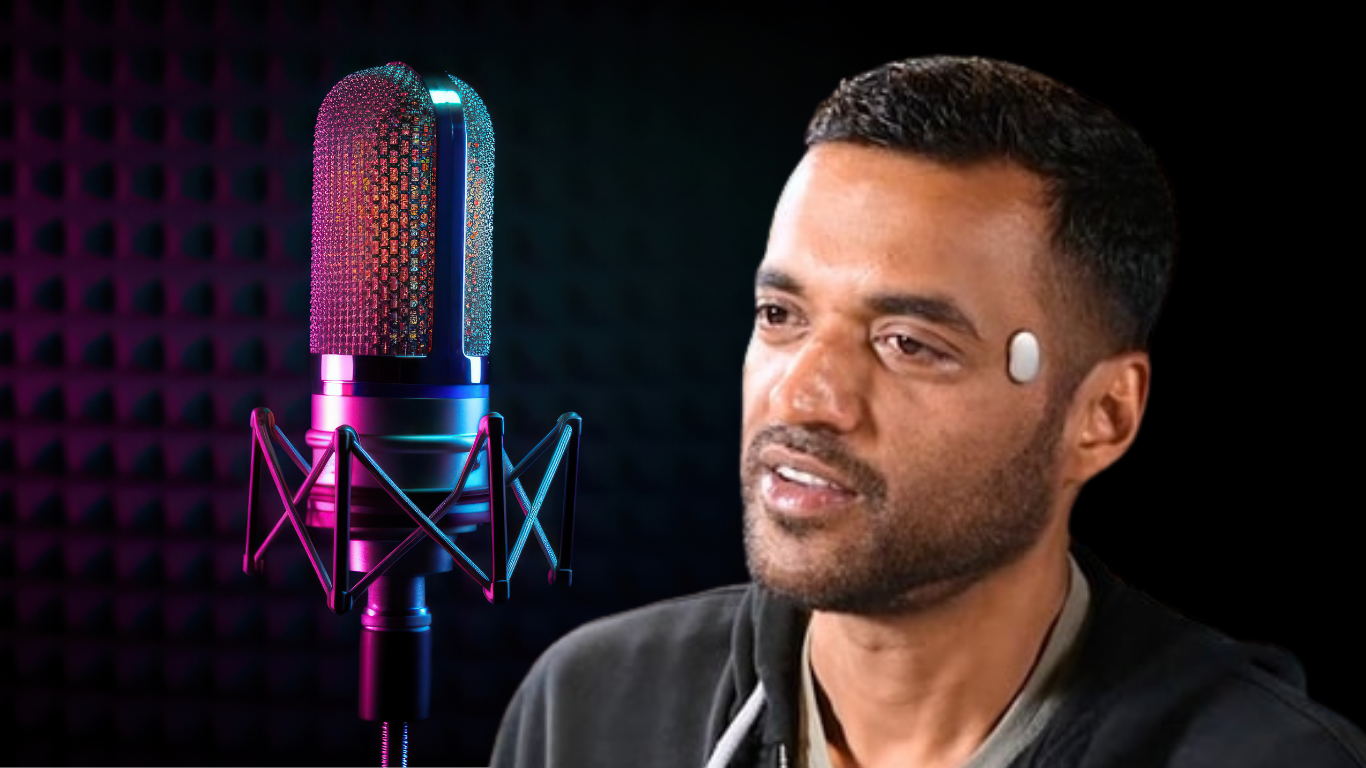
It originated with an appearance on a podcast. As Zomato founder and CEO Deepinder Goyal sat down for Raj Shamani’s Figuring Out podcast, listeners saw something strange: a tiny, metallic gadget attached close to his temple. Social media erupted with questions, memes, and speculations in a matter of hours. Was that a microphone? A futuristic brain implant? An external SSD?
The response proved to be more fascinating—and contentious—than anybody had anticipated.
What Is Temple?
Temple is an experimental peripheral brain monitor that tracks cerebral blood flow in real time. According to Goyal, the gadget integrates modern sensors and AI-driven analysis to continually measure cerebral blood flow during daily activities, something conventional medical equipment can only perform during brief clinical testing.
The little gold- or silver-colored sensor rests near the temple and seeks to offer information on brain health, cognitive performance, and aging. Goyal has put up roughly $25 million (Rs 225 crore) to fund this study through his own research enterprise, Continue Research.
However, here’s what makes this tale so intriguing: Temple is not a Zomato product. It’s not even available for sale. It is a prototype that Goyal has personally tested for the last year as part of his research on human longevity.
The Gravity Aging Hypothesis
Behind Temple is an uncommon idea known as Goyal’s “Gravity Ageing Hypothesis.” The concept is simple yet provocative: because individuals spend most of their time sitting or standing erect, gravity may impede blood flow upward to the brain.
Goyal believes that over time, this slight drop in cerebral blood flow caused by resisting gravity when standing might hasten the aging process. Temple, in principle, would monitor these changes in real time and provide data to evaluate this notion.
It’s an interesting notion. Zero gravity has been demonstrated to damage astronauts’ bones, muscles, and circulation. However, extrapolating this to argue that gravity directly influences human lifetime on Earth is very speculative.
The Medical Pushback
When medical professionals joined in on the viral moment, it immediately became a source of contention.
Dr. Suvrankar Datta, an AI researcher and radiologist at AIIMS Delhi, provided one of the most pointed comments. As a physician-scientist and early researcher in arterial stiffness and pulse wave velocity, he ensured that the gadget presently has no scientific standing as a helpful device, advising consumers against spending money on what he described as “fancy toys billionaires can afford to waste money on.”
The Core Scientific Concerns
Medical experts raised several critical issues:
1. Lack of Validation
There is presently no publicly available clinical evidence proving that Temple can reliably detect cerebral blood flow in people in real-world scenarios. Experts say that the technique is still untested, as it has not undergone thorough testing, clinical trials, or regulatory assessment.
2. Measurement Method Issues
According to Dr. Datta, carotid-femoral pulse wave velocity (cfPWV) is the sole scientifically proven measure for cardiovascular mortality. He argued that utilizing the temporal artery (near the temple) as a proxy is scientifically unsound owing to confounding variables and a lack of precision. The arteries around the temple aren’t good markers of total cardiovascular or cerebral blood flow.
3. The Gravity Hypothesis Itself
When asked if the Gravity Ageing Hypothesis has a scientific foundation, Dr. Datta was unequivocal: “At the moment, there is none.” Considering what we currently know about astronauts and the effects of microgravity, the theory isn’t utterly absurd, but it’s still considered conjecture rather than proven science.
Goyal’s Response: “Wait for the Science”
Rather of backing down, Goyal responded to the criticism, however not in the way one might anticipate.
In a post on X, Goyal sent a “gentle reminder” to physicians and influencers, emphasizing that Zomato had made no public commercial announcements concerning Temple.
His key points:
– No commercial launch: the gadget is not for sale and cannot be pre-ordered.
– No official data: The benchmarking results have not been disclosed.
– Months away from preview: If Temple becomes a product at all, it is still in the early stages.
– Science will arrive:He vowed to provide the underlying science “if and when we decide to sell.”
“Your skepticism is valuable, but at the right time,” Goyal wrote, making a larger call to assist Indian businesses in their early phases of development.
He thought it hilarious that individuals were warning others not to buy something that didn’t yet exist. That’s right!
Goyal also provided constructive criticism. When Dr. Sudhir Kumar, a neurologist at Apollo Hospitals Hyderabad, recommended testing blood flow along the internal carotid artery in the neck rather than the temporal artery, Goyal responded with a light-hearted emoji.
The Bigger Picture: Innovation vs. Validation
The Temple dispute reveals an intriguing conflict in current health tech:
The Innovator’s View:
Entrepreneurs like Goyal claim that successful technologies frequently begin with unusual ideas and personal exploration. They invest their own money, test prototypes on themselves, and tweak ideas prior to official confirmation. They want the freedom to explore without being judged.
The Medical Community’s View:
Doctors and scientists argue that health-related statements require thorough evidence before being made public. When a well-known CEO wears an experimental technology on a prominent podcast, it might generate hype and mislead people about what’s scientifically established. The issue is more than simply wasted money—it’s also about public faith in medical science.
Both viewpoints have reliability.
Experimentation and willingness to accept early-stage uncertainty. However, when it comes to health devices that aim to assess physiological characteristics, the standard for proof must be set high—especially when they are promoted to the general public.
What Happens Next?
For the time being, Temple remains precisely what Goyal describes it as: a prototype. Not a product. This is not a proven medical device. An experiment.
Goyal has stated that Temple is still in the works, and an open trial might last months if an advertisement launch is ever planned. Assuming Temple’s work is commercialized, the business has vowed to provide more information about its research.
If Goyal and his research team can produce deliverable validated data—clinical trials, peer-reviewed publications, independent testing—Temple will pave the way for a new type of wearable brain-health technology. Brain blood flow is well acknowledged as an essential measure of cognitive health and aging.
However, until that data becomes available, Temple is caught between a visionary idea and untested device.
The Takeaway
The Temple device story is more than simply a viral tech sensation. It exemplifies how innovation, celebrity influence, and medical skepticism mix in the age of social media.
Deepinder Goyal isn’t claiming to have a miracle innovation. He freely describes Temple as experimental, self-funded research. He’s appealed for patience and pledged to be transparent when appropriate.
Medical professionals aren’t being pessimistic. They protect public health by requiring proof before making claims, reminding us that fascinating ideas must undergo thorough testing before becoming trusted instruments.
What about the public? We’re observing this happen in real time, learning to discriminate between:
– A billionaire’s own experiment
– A validated medical device
– And everything in between
Perhaps the most significant lesson is that curiosity, like skepticism, can be helpful in health and wellness. Innovation merits encouragement, but exceptional promises need extraordinary evidence.
For the time being, the Temple device is what it has always been: an interesting question mark awaiting answers from science.
What are your thoughts? Is Goyal a visionary pushing the limits of health tech, or is it a case of untested wellness trends receiving too much attention?