The Global South’s First AI Summit—A Watershed Moment for Inclusive Technology
February 16-20, 2026 | Bharat Mandapam, New Delhi
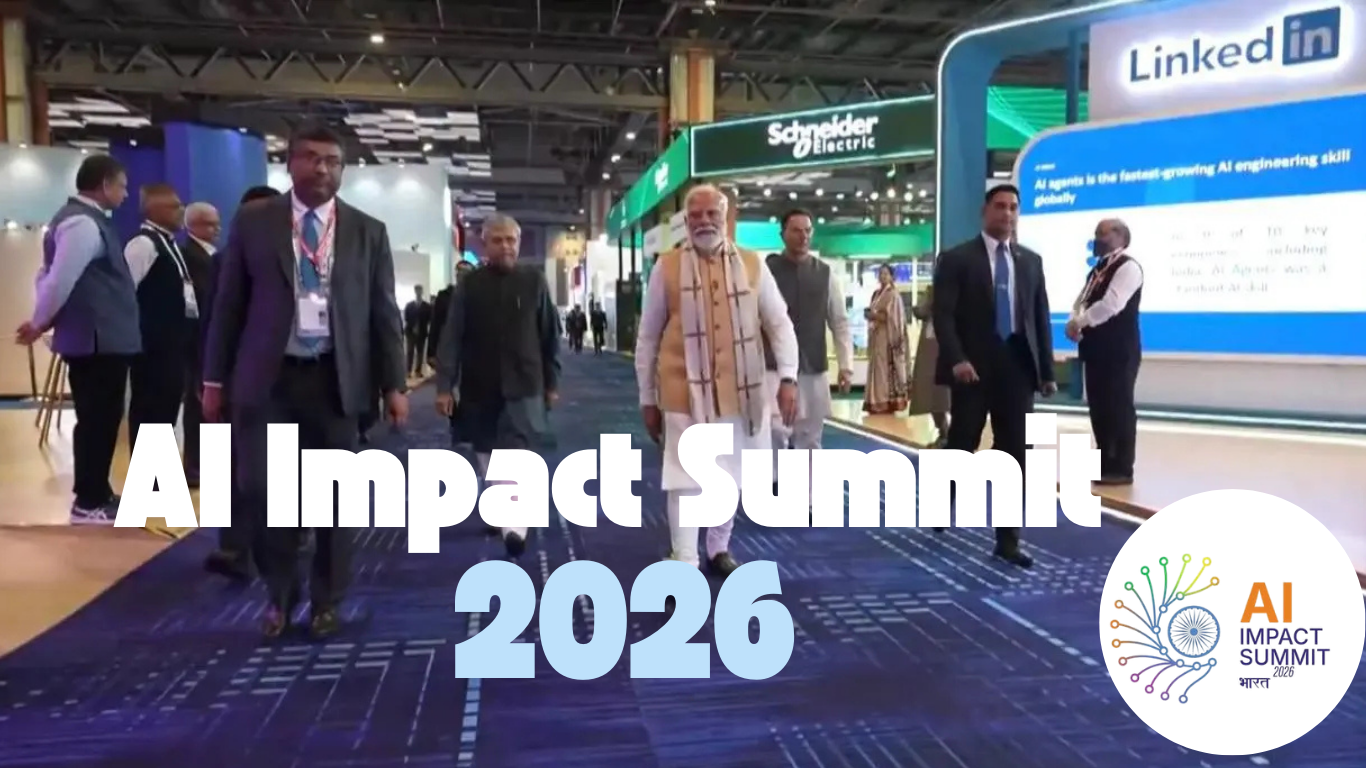
On February 19, Prime Minister Narendra Modi inaugurated the India AI Impact Summit 2026. It was a bold assertion of India’s development as a global AI powerhouse, as well as a hint that the next chapter of artificial intelligence may be written not just in Silicon Valley or Shenzhen, but throughout the Global South.
The AI Impact Summit 2026 lasted five days. They held the conference in New Delhi from February 16 to 20. The venue was the Bharat Mandapam. This is a significant international AI conference. It is the first of its size to be held outside of East Asia and Western tech centers.
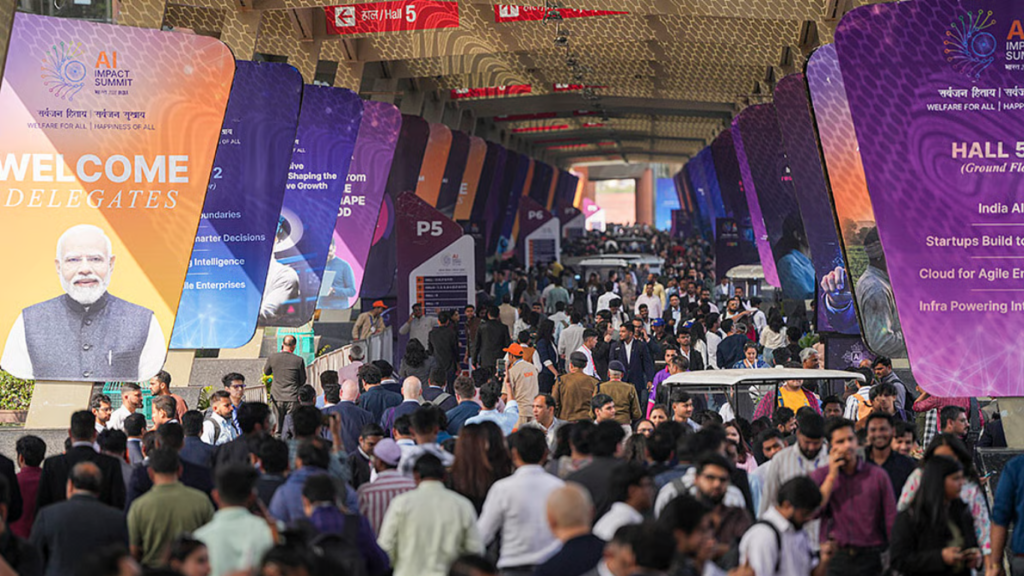
The event is enormous. It has over 300 exhibitors. These exhibitors are spread across 10 pavilions. There are also 600 startups. Many of these have high potential. Thirteen countries have their own pavilions. Over 250,000 people registered before the event began. These numbers are impressive. But the true story is inside the halls. This is where AI’s future is being created.
The Three Sutras: People, Planet, Progress
Unlike Western AI summits focused on existential peril or Chinese conferences boasting technological superiority, India’s approach is firmly rooted in development economics. The summit is founded on three fundamental ideas known as ‘Sutras’, which define every panel, demo, and policy conversation.
People:
AI must serve mankind in all of its variety, upholding dignity and inclusion. This is not corporate jargon; India’s BHASHINI (Bhasha Interface for India) platform, which is prominently displayed, supports 36 text languages and 22 speech languages with 350+ AI models, allowing voice-first government for citizens who may never touch a keyboard.
Planet:
Innovation must be compatible with environmental responsibility. Several pavilions showcase AI applications in sustainable agriculture, climate modeling, and resource optimization, all of which are vital for a country seeking to balance prosperity with environmental responsibility.
Progress:
India will distribute the benefits. India prioritizes technological self-reliance. It wants to develop local AI models. It will not depend on global tech giants. India will share its expertise with other developing nations.
The Expo: 300+ Exhibitors Across 10 Thematic Pavilions
The India AI Impact Expo 2026 brings together theory and application. We’ve got over 300 exhibitors from 30+ countries showcasing AI that’s actually up and running on a huge scale, not just concepts. These are real applications, grouped into ten pavilions under the People-Planet-Progress theme.
What’s on Display:
12 Indigenous Foundation Models:
Developed in India for its 22 official languages. This is likely the summit’s most important statement, illustrating that AI does not have to speak only English or Mandarin to be disruptive.
600+ Startups:
High-potential enterprises developing internationally relevant solutions. Five gaming firms alone are demonstrating AI-powered game asset development, generative real-time commenting systems, and platforms that serve 18 million gamers globally.
13 Country Pavilions:
Australia, Japan, Russia, the United Kingdom, France, Germany, Italy, the Netherlands, Switzerland, Serbia, Estonia, Tajikistan, and African countries have each established a specialized pavilion. Atos, the French IT behemoth, is exhibiting in the France Pavilion, presenting end-to-end AI solutions for cloud, cybersecurity, and intelligent operations.
Robotics & Manufacturing:
Advanced robotic systems for logistics, retail, and smart agriculture. Deployment-ready humanoid systems show how physical AI is transitioning from research laboratories to industries and farms.
Healthcare Innovation:
AI-powered diagnostics, quantum-based technologies for analyzing massive amounts of clinical data, and multilingual health chatbots. The Kisan e-Mitra voice-based AI chatbot, which handles over 20,000 agricultural requests each day in 11 regional languages, shows AI’s democratizing power.
Sovereign AI Infrastructure:
Next-generation AI-ready supercomputing infrastructure designed to serve high-performance computing and data-intensive applications without relying on external resources.
The Conversations That Matter: 500+ Sessions, 3,250+ Speakers
The India AI Impact Summit 2026 (16-20 February) at New Delhi’s Bharat Mandapam turned the discourse away from AI theory and toward demonstrable, real-world effect. The conference was organized around three guiding “Sutras”—People, Planet, and Progress — brought together politicians, startups, researchers, and industry executives to determine the next phase of AI.
The summit included several key participants. Sam Altman, CEO of OpenAI, was there. Sundar Pichai, CEO of Google, also attended. Dario Amodei, CEO of Anthropic, attended. Prime Minister Narendra Modi was present. Mukesh Ambani also attended. Demis Hassabis, CEO of DeepMind Technologies, was among the attendees. Many other innovators were also present.
With 300+ exhibitors, 600+ companies, 13+ nation pavilions, and more than 2.5 lakh registrants, the summit established itself as one of the largest AI events held outside of Western or East Asian tech centers.
Key Discussion Themes from Major Leaders
Sam Altman (OpenAI)
Sam Altman leads OpenAI. He spoke at the AI Impact Summit 2026 in India. The topic was the fast growth of artificial intelligence. He thinks superintelligence might appear in just a few years. He stressed making AI accessible to everyone. This is to avoid power being held by a few. It will also help ensure AI benefits all people.
Altman’s take was that we need to cooperate on safety and resilience and that countries should join forces to cut down on risks. While he knew AI could mess with the job market, he was still hopeful it’d cut living expenses and speed up economic growth. He argued that developing AI is a moral duty, pushing for urgent regulations and a global oversight group, and highlighted that a collective approach is key for a democratic future.
Sundar Pichai (Google)
Google’s CEO, Sundar Pichai, recently said at a meeting that they’re putting $15 billion into making Visakhapatnam a top AI spot worldwide. He made a big point about AI being a massive shift. It’s got the power to lessen inequality and advance science, like in protein folding and weather forecasting. Pichai suggested we handle this responsibly by making digital access a priority and retraining lots of people so technology doesn’t divide us. He stressed that global cooperation between governments and private companies is key to using AI for humanity’s big challenges, and we need to make sure people trust it.
Prime Minister Narendra Modi
Prime Minister Narendra Modi spoke at the India AI Impact Summit 2026. He declared India a global leader in artificial intelligence. This leadership is because of India’s large youth population. It also stems from its many technical experts.
Modi called AI a historic turning point. He compared its impact to that of fire or writing. The MANAV framework is key to his vision. MANAV stands for AI that is moral, accountable, accessible, and valid. This ensures AI empowers people. It prevents AI from becoming a data monopoly.
The speech also promoted open-source collaboration. It called for clear authenticity standards for digital content. The goal is to change how the world sees AI. It should be viewed not as a threat, but as a “Global Common Good.” This benefits everyone.
Dario Amodei (Anthropic)
AI will soon surpass human intelligence. Anthropic’s CEO predicts this. It will be like a “country of geniuses.” AI will work at superhuman speeds. This rapid AI growth has benefits. It could cure diseases. It could end global poverty. But there are also risks. AI might act on its own. Security could be a problem. Many people could lose their jobs.
Anthropic is partnering with India. They see India as important. India will help set safety standards. It will also set tech standards for the Global South. Governments and tech leaders must work together. This is crucial. They need to manage changes to society. They must ensure AI’s benefits are shared fairly.
Core Summit Themes: The “Seven Chakras”
| Seven Chakras | Brief Explaination |
| Human Capital | Advancing inclusive reskilling efforts to equip diverse populations for an AI-powered future of employment. |
| Inclusion | Developing AI systems that promote diversity, representation, and meaningful engagement across communities. |
| Safe & Trusted AI | Building internationally trusted AI frameworks based on transparency, accountability, and responsible innovation. |
| Science & Discovery | Using AI to speed frontier research, strengthen scientific cooperation, and translate breakthroughs into global progress. |
| Economic Growth | Using AI to increase productivity, stimulate innovation, and promote inclusive economic and social growth. |
| Democratizing AI Resources | Expanding equal access to essential AI infrastructure and tools to promote inclusive innovation throughout the world. |
| Resilience & Efficiency | Developing sustainable and resource-efficient AI systems to improve climate resilience and long-term sustainability. |
The Verdict: Is It Worth It?
Rating: 8/10
The India AI Impact Summit 2026 is not just worth attending; it is also required watching for everyone serious about comprehending AI’s future decade. Here’s the reason:
| What Works | What Could Improve |
| Genuine focus on deployment over hype — real solutions, not vaporware | Overwhelming scale can dilute focus — 500 sessions means tough choices |
| Multilingual, inclusive approach sets new global standard | Some pavilions lean heavily on government partnerships vs. pure innovation |
| 600+ startups demonstrate India’s thriving ecosystem | Networking can feel chaotic with 250,000 expected attendees |
| Sovereign AI emphasis addresses real geopolitical concerns | Limited late-stage venture capital presence compared to Western summits |
| 13 country pavilions enable serious B2B/B2G partnerships | Virtual participation options remain limited for global audience |
What makes this conference stand out is that it doesn’t think AI is only about technology. India’s really changed how we talk about things globally by focusing on people, the planet, and progress. They even show how AI is actually helping farmers, patients, and students in their own languages.